All posts by SJM Test

NAIDOC Week: William Cooper’s legacy

NAIDOC Week: William Cooper’s Legacy

The roots of NAIDOC Week can be traced back to the 1920s and 30s when First Nations rights groups took formation and staged boycotts and marches on the Australian government.

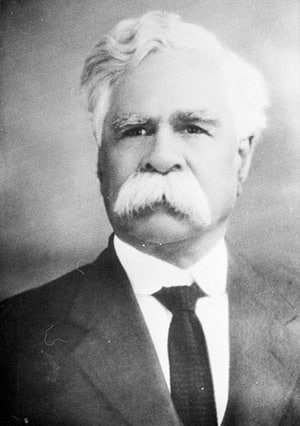
Instrumental in these actions was William Cooper, who led the 1938 Day of Mourning march, which demanded constitutional powers for Aboriginal people.

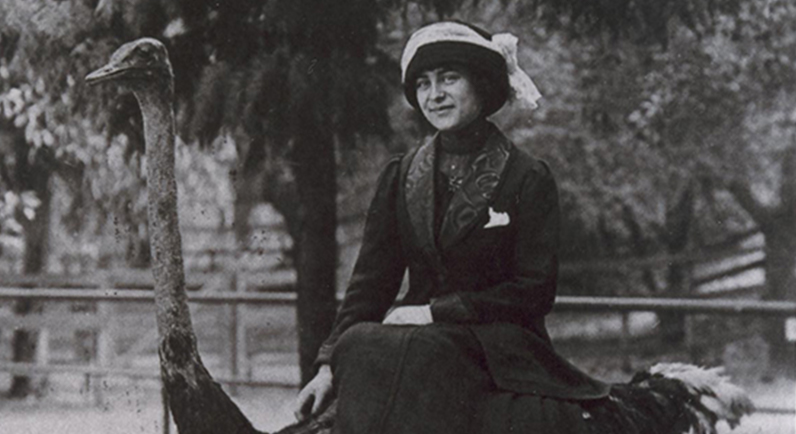
📷 William Cooper, circa 1937.

Cooper holds a special position in the Sydney Jewish Museum for his incredible empathy for the plight of all persecuted peoples, including the Jews of Europe.

On November 9-10,1938, Jewish businesses, synagogues, houses and schools were destroyed, dozens of people were killed and 30,000 men were arrested and taken to concentration camps, in what is known as Kristallnacht — the night of broken glass – the pogrom that would become the precursor to the Holocaust.

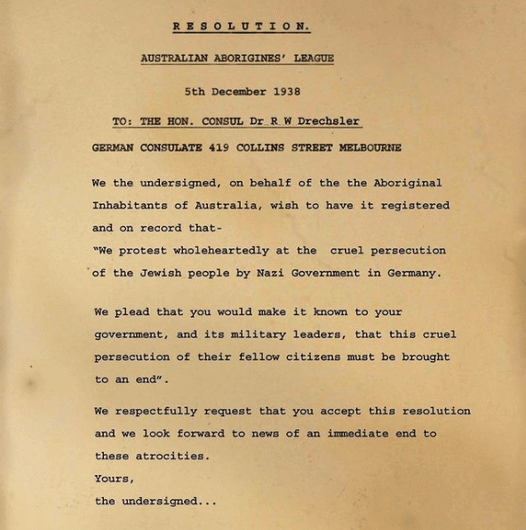
It sent a wave of fear and terror through Germany, Europe and the rest of the world and William Cooper could not stay silent. Cooper was quickly moved to action and led a march on the German Consulate in Melbourne.

He and his delegation were refused entry, and little attention was attracted to the cause at the time. However, 72 years after his efforts, Cooper was honoured by Yad Vashem. Cooper’s legacy is recognised in our Holocaust exhibition for his outreach to the Jewish community. You can also find him recognised in our Holocaust and Human Rights exhibition for his immense efforts for the rights of First Nations Australians.

Cooper’s descendants retain their close affiliation with the rights of oppressed peoples and continue to honour them through the Museum, as a place for the promotion of the rights of all.


Image: Reconstruction of the petition by Australian Aborigines’ League in 1938 (detail). Courtesy of the Cooper Family. 

In love and Auschwitz

In love and Auschwitz

This is an intriguing story of resistance and survival. Born in 1914 in a small Polish village, Salem Schott moved with his family to Berlin after the First World War.

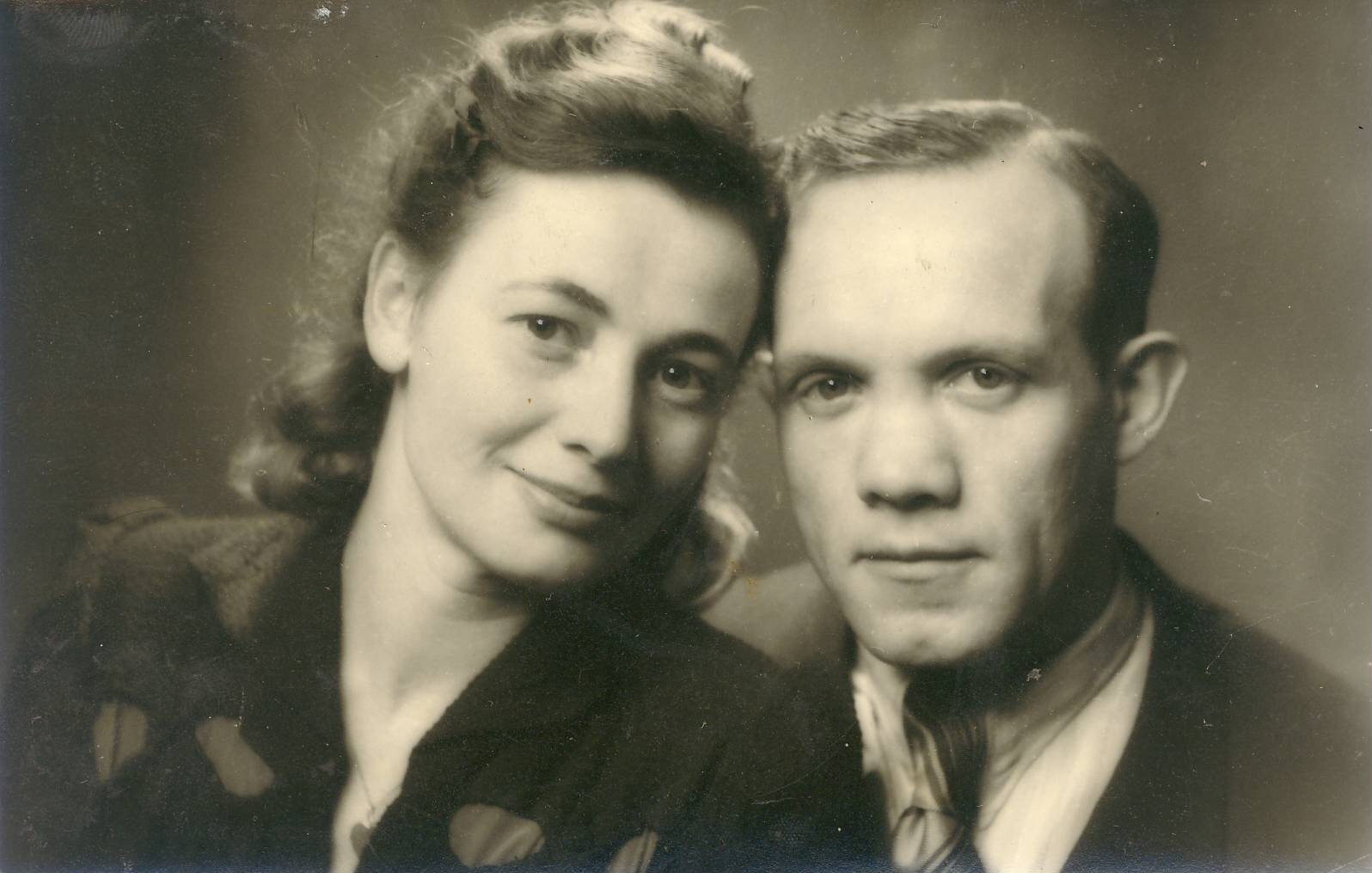
After finishing primary school he completed an apprenticeship as a metal worker and electrician. Aged 16, he embarked on a boxing career with the Jewish Makkabi sports club, quickly earning the reputation as a tough fighter, a champion in his light-middle weight class, nick-named “Bully”. In 1937 he met his future wife Gerda Lewinek in the Jewish Youth movement.

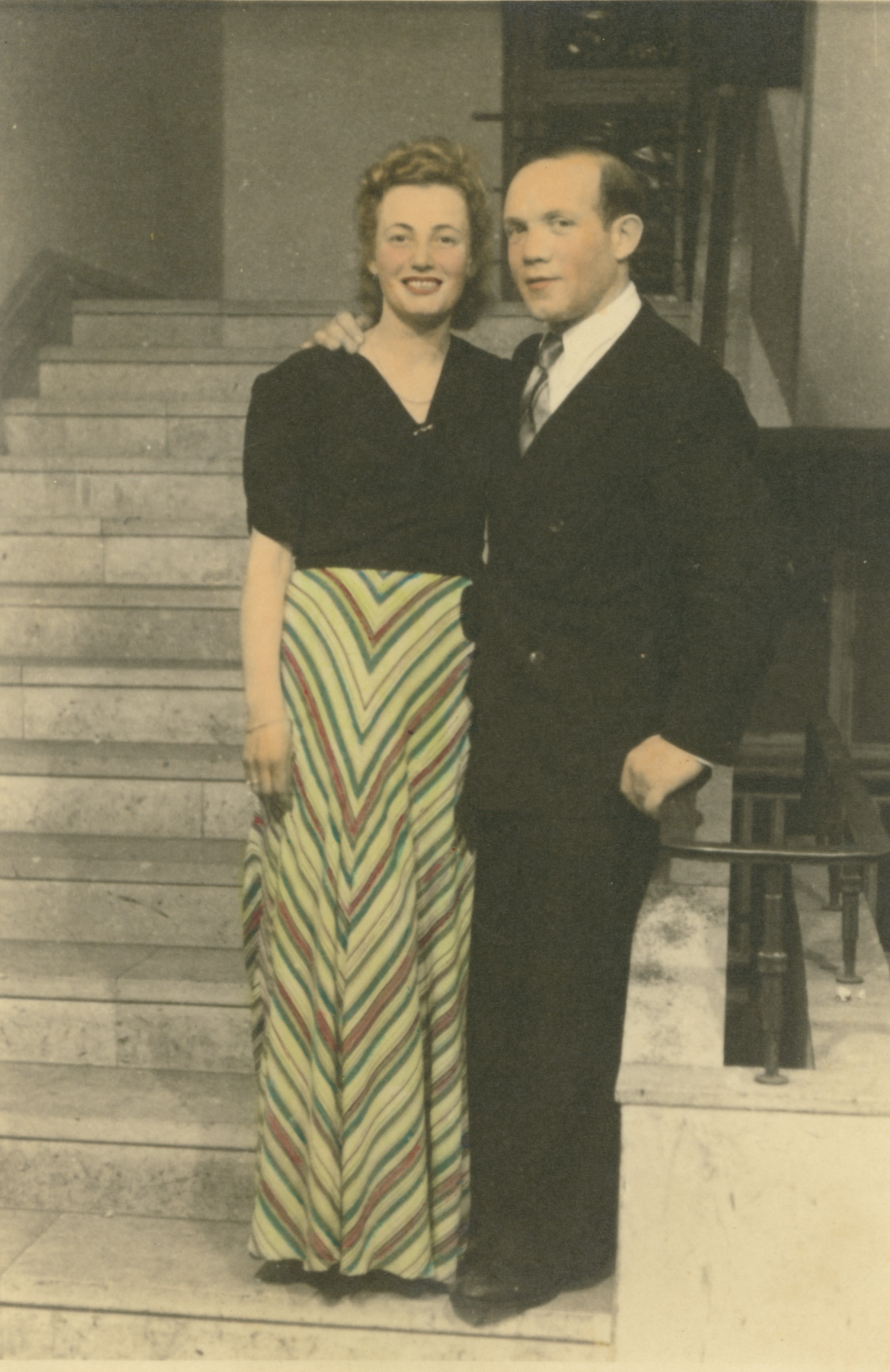
Gerda Lewinek and Salem Schott.

Gerda Lewinek and Salem Schott. Image: SJM Collection

As a German Jew of Polish descent ‘Bully’ was taken hostage in September 1939.  Physical strength helped him in the concentration camp of Sachsenhausen to adjust to brutal treatment and harsh labour. His boxing skills also proved valuable, earning him status and extra food rations when participating in boxing matches. Highly beneficial was his friendly relationship with inmates who stood at the top of the camp hierarchy.

‘Bully’ was deported to Auschwitz on October 23 1942.  Here too, his skills as an electrician and welder were in high demand, earning him special privileges and the ability to move freely around the camp. He again befriended Gerda and as well as a civilian worker who would later help him escape.

On August 16 1944, ‘Bully’ was locked inside a workshop, and after dark he changed his clothes, cut through the wire fence and made his way to the train station. The journey to Berlin lasted several weeks. Upon arrival, he disappeared into the underground with the help of Berliners who provided false papers, ration cards and accommodation. Whilst his escape was discovered on August 17, the Gestapo never found him. All together 667 escapees were recorded; 270 escapees were caught and executed. ‘Bully’ is one of only 76 Jews who successfully escaped from Auschwitz.

After liberation in June 1945, Gerda and Bully were married. It was one of the first Jewish weddings in Berlin after the Holocaust. Both hastened to trace Nazi killers and to bring them to justice. After their son Martin was born the family migrated to Australia arriving in November 1950. They found a new and permanent home the suburb of Maroubra.

Bully and Gerda Schott: SJM Collection

Bully and Gerda Schott: SJM Collection

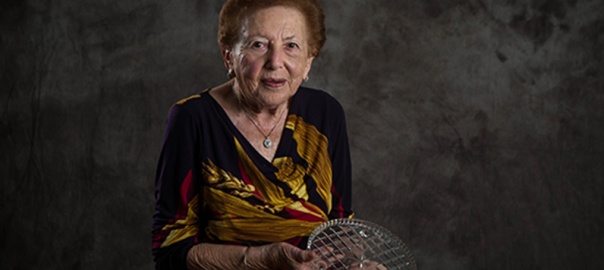
Survivor Portraits - Vera Faludi

Survivor Portraits – Vera Faludi

Survivor Portraits – Vera Faludi (1929-2026)

Vera was born in 1929 in Sofia, Bulgaria.

In Sofia, Vera attended an Italian pre-school, a Hungarian school, and then a German school with her brother Teddy. By the end of 1939, Jewish children were no longer allowed at German schools, and Vera moved to a French school run by nuns. Languages were important to her father. He thought they could open doors. This, Vera said, was a partial reason for her family’s survival.

In 1942, a friend of Vera’s father at the Hungarian Embassy offered to move, via diplomatic courier, the family’s most valuable belongings from Sofia to Budapest – Persian carpets, paintings, porcelain. However, their belongings never arrived. They were most likely stolen by the diplomat.

Teddy and Vera’s father were sent to forced labour, and Vera and her mother had to move into the ghetto. One day, Arrow Cross soldiers came and took all of the women aged 16 to 60 from the ghetto. Vera, her mother and her grandmother all hid in the attic. The attic space was so small that they had to stay lying down or in a half-seated position. They stayed here for a week, after which they managed to procure papers to move into a protected house of the Swedish consulate in Hungary.

One day, after the war, a dirty, skinny man approached Vera and she began to run away. She heard a voice, ‘Don’t you recognise me?’ It was her brother.

Shortly after liberation, Vera met with an old friend, George Faludi. She was 16 years old. They were married in early 1946, and left Hungary in 1947 for Brussels, where they stayed for eight months waiting for visas. George and Vera went to Paris, and by 1948, with false visas, left for Uruguay. They immigrated with their family in 1971 to Australia.

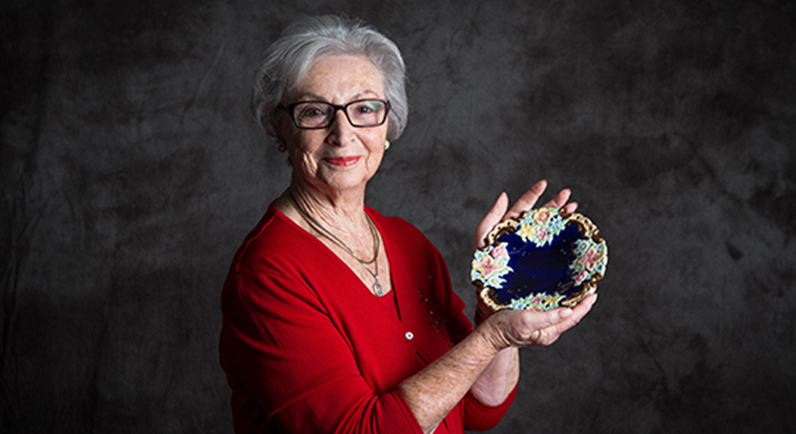
Vera and George took few belongings when they escaped from communist Hungary. This dessert plate pictured is one of six which Vera took to remind her husband of his mother’s baking and the desserts they enjoyed.

To read more from our Survivor Portraits blog series, click here.

To explore the personal stories and anecdotes of Holocaust survivors, click here for our first online exhibition.


Photograph by Katherine Griffiths.

Survivor Portraits - John Gruschka

Survivor Portraits – John Gruschka

Survivor Portraits – John Gruschka (1924 – 2025)

This month we introduce John Gruschka. John was born in Aussig, Czechoslovakia in 1924.

John grew up in the German-speaking park of Czechoslovakia, where there was a small but significant Jewish population. When the National Socialist party ascended to power, local Jewish families started to flee from the perceived Nazi threat. John’s family made a hurried exit to the Czech capital of Prague in 1938, in the nick of time.

As storm clouds gathered over Europe, John’s family searched for escape routes to leave the country. John’s father and sister went to Palestine, and John was sent to the safety of a distant relative in Manchester, England.

John’s mother, committed to caring for her own frail mother, stayed behind. John’s last farewell with his mother took place at the Prague railway station in February 1939, when he was just about to turn 15. He would never have conceived that this could be his and his mother’s last goodbye.

Hoping for a family reunion in Palestine, John’s mother Helene took up language studied in Hebrew during the Nazi occupation. Whilst sheltered safely in England, John received many letters from Helene in Prague. She encouraged John to practise violin, took interest in his schooling, and continued to mother him as best she could from afar. The Red Cross message service facilitated their communication.

On 8 September 1942, Helene was transported to Theresienstadt concentration camp, and on 1 February 1943, she was sent in a transport to Auschwitz, where she was murdered at the age of 53.

John immigrated with his wife to Israel to join his father and sister in 1950, and moved to Australia ten years later in 1960.

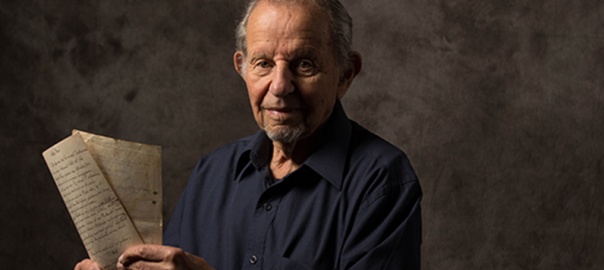
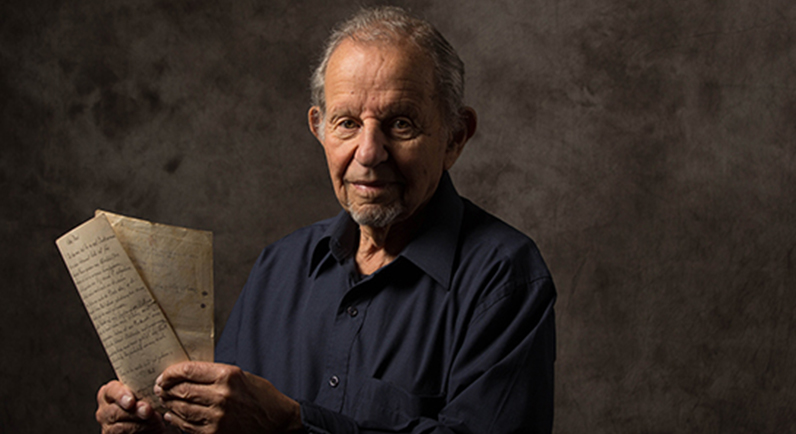
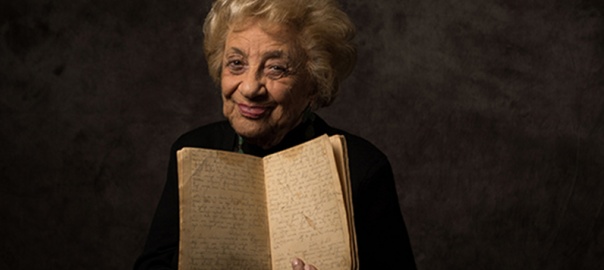
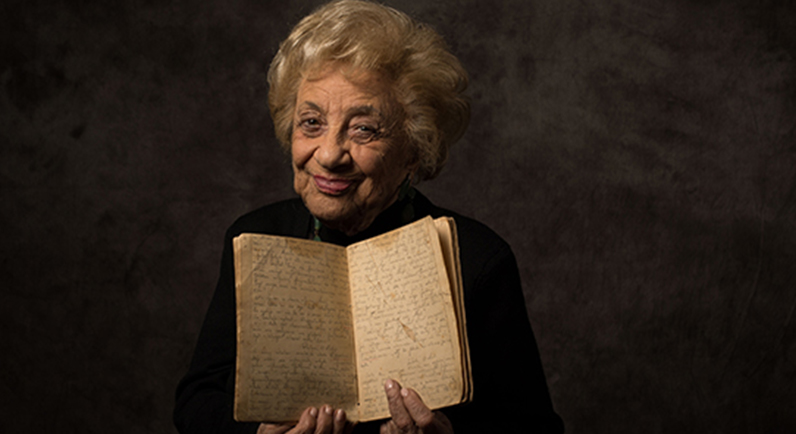
The Sydney Jewish Museum has preserved John and Helene’s letters. In this photo, John holds one of the many letters that was sent to him by his mother in Prague.

To read more from our Survivor Portraits blog series, click here.

To explore the personal stories and anecdotes of Holocaust survivors, click here for our first online exhibition.


Photograph by Katherine Griffiths

International Museum Workers Day: A Profile on Resident Historian Konrad Kwiet

International Museum Workers Day: A Profile on Resident Historian Konrad Kwiet

International Museum Workers Day: A Profile on Resident Historian Konrad Kwiet

Thursday 28 June is International Museum Workers Day. On this day, we recognise our longest serving staff member, Resident Historian Emeritus Professor Konrad Kwiet, whose service to the Sydney Jewish Museum predates its official opening 25 years ago.

Konrad was instrumental in the creation of the historical framework for the Museum during its inception: he was the critical eye that governed the historical accuracy and authenticity of the proposed exhibition content. As the Museum’s collection, professional team and body of knowledge have grown over the years, Konrad has continued to ensure authenticity and best practice of collecting, curating and presenting the historical period of World War II and its aftermath.

Konrad’s academic clout is well-recognised among historians. He was appointed as Chief Historian at the Australian War Crimes Commission (SIU) in the mid-1980s, where he provided invaluable assistance in its belated attempt to bring Holocaust perpetrators residing in Australia to justice. He has read and listened to more than 1,000 testimonies of Holocaust survivors, and has published 10 books and more than 100 articles.

From a historian’s perspective, Konrad maintains that what is more important than teaching people facts, “is making them aware of what they themselves derive or conclude from the facts. We need to build and enhance critical awareness so that people question, try to find answers and develop the capacity to think critically.” Professor Kwiet prides the Museum on its ability to maintain relevance by “providing this trigger to think, question authority, question the past and question tradition.”

The Museum is incredibly fortunate to have had Konrad’s ongoing input on all of its projects, exhibitions and programs, and is perpetually humbled by his immense expertise.


Photograph by Katherine Griffiths.

World Refugee Day: Bridging the gap

World Refugee Day: Bridging the gap

World Refugee Day: Bridging the gap

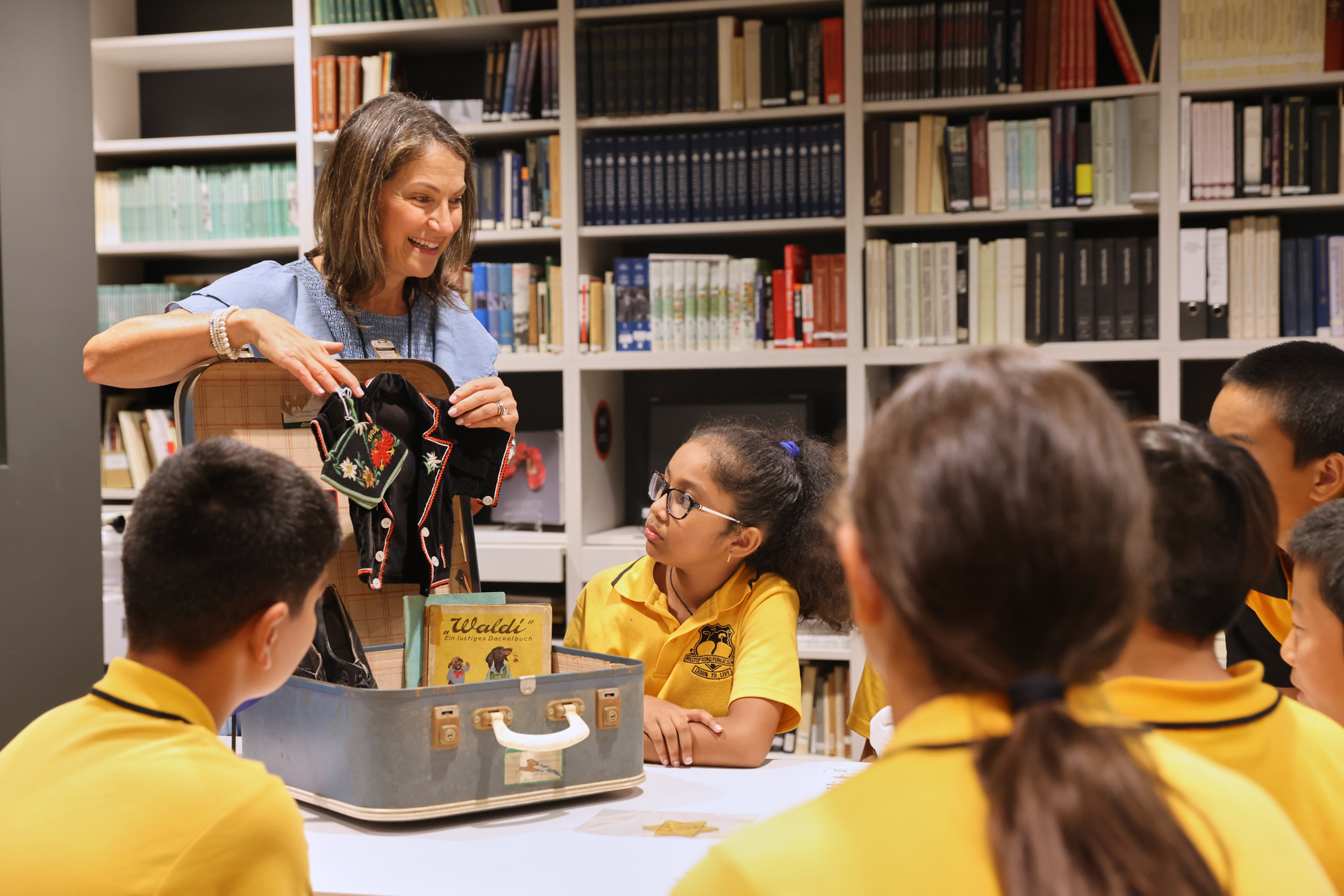
Today is World Refugee Day: an annual global day of commemoration and a vehicle through which to raise awareness about issues affecting refugees. It is also a time to celebrate  the  positive contributions of refugees to their respective societies. In keeping with this year’s theme, #WithRefugees, we recount an encounter from a recent school visit to the Sydney Jewish Museum that serves as a reminder of the courage and resilience of refugees, and the importance of bridging gaps of experiences through the sharing of stories.

In the last year, primary school students made up ten percent  of the 25,000 students visiting the Sydney Jewish Museum. The Museum’s Education Department gets vicarious pleasure when primary school students eagerly ask questions to Holocaust survivors. Their curiosity is contagious and our survivors feel fulfilled after speaking to these young visitors.

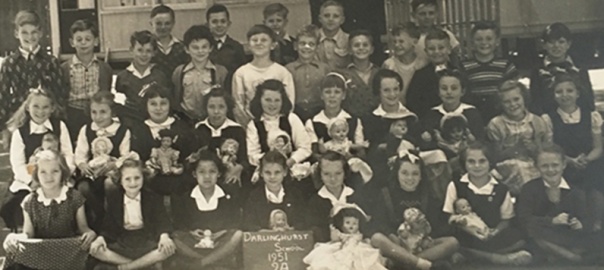
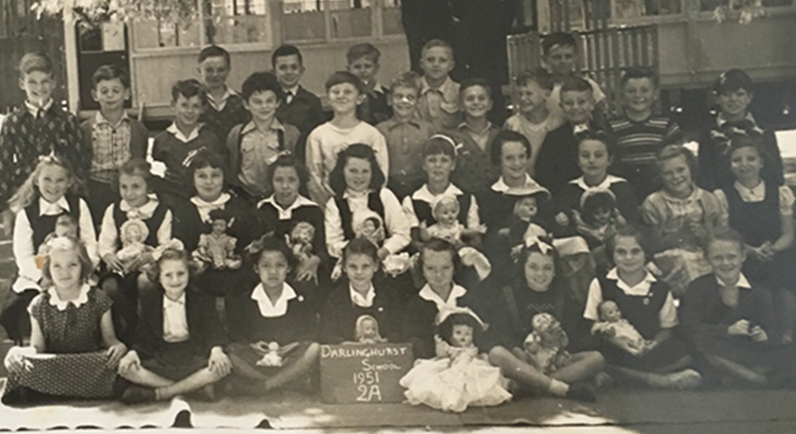
Last month the Museum welcomed Darlinghurst Public School’s Year 6 class; a school from our own neighbourhood. The class listened spellbound as Holocaust child survivor Alice Loeb shared her testimony.

Alice shared the story of her parents’ struggle and her family’s survival in Switzerland as stateless Jews during WWII. After the war, Alice’s parents, both from the same neighbourhood in Vienna, Austria, tried to gain Swiss citizenship. This, however, was denied to them, and as refugees in Switzerland, they were obliged to report weekly to the police station. At  the age of three, Alice came with her parents and baby brother as refugees to Sydney, Australia, on the Dutch liner, Johan de Witt. Alice’s family moved into a tiny apartment on William Street in Kings Cross, where Alice attended Woolloomooloo Preschool. There she has an early memory of a girl calling her a “dirty Jew”; something she did not comprehend at the time but has never forgotten.

The next turn of Alice’s story delighted the Year 6 class: she revealed that, at the age of 5, she started primary school at Darlinghurst Public School. The students were palpably overjoyed to claim Alice as one of their own, and proceeded to probe her with questions about what their school was like all those years ago. They commiserated on hearing about her scratchy serge tunic and were amazed that boys and girls were separated in class and on the playground. The students found it hard to believe that this feisty Holocaust survivor, who had them eating out of the palm of her hand, was once a timid pupil at their school.

Alice’s story, and the diverse stories that Holocaust survivors deliver daily in the Museum, are constant reminders of the dignity and hope that lay within people who are forced to seek refuge from persecution. This is a universal lesson that we find in experiences of the Holocaust and continue to see beyond barriers of time and geography, more than 80 years after the rise of Nazism.

Image: Holocaust child survivor Alice Loeb (Second row, first on the right) at Darlinghurst Public School, 1951, SJM Collection.

Holocaust survivor awarded Order of Australia Medal

Holocaust survivor awarded Order of Australia Medal

Holocaust survivor awarded Order of Australia Medal

The Sydney Jewish Museum is proud to announce that Holocaust survivor Yvonne Engelman, long-serving volunteer at the Sydney Jewish Museum since its inception in 1992, was recognised on the Queen’s Birthday honour list with a Medal of the Order of Australia.

Yvonne received a medal for her service to the Jewish community through her intimate and dedicated involvement with the Museum for over 25 years, her service to the Australian Association of Jewish Holocaust Survivors and Descendants, as well as the Board of Jewish Education.

Yvonne was born in 1927 in Dovhe, Czechoslovakia. She was deported to the Berehove ghetto, where she was held for four months, before incarceration at Auschwitz-Birkenau in 1944. An only child to her parents and an only grandchild to her grandparents, Yvonne was the sole survivor of her family upon liberation in 1945.

She moved to Australia in 1948 where she met her husband, John, who was also a survivor. Together they worked hard to learn English, re-establish themselves and raise a new family.

The Sydney Jewish Museum congratulates Yvonne Engelman alongside Volunteer Manager Rony Bognar and all other deserving community members for the recognition received for their service to diverse aspects of the Jewish and wider Australian community.

Image: SJM Collection. Photograph by Katherine Griffiths.

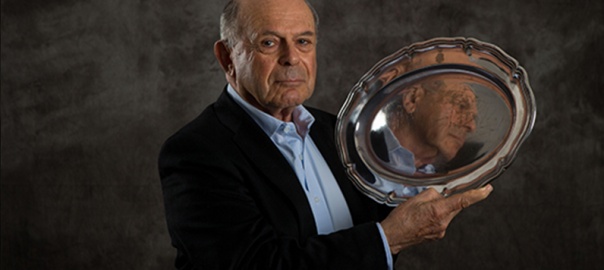
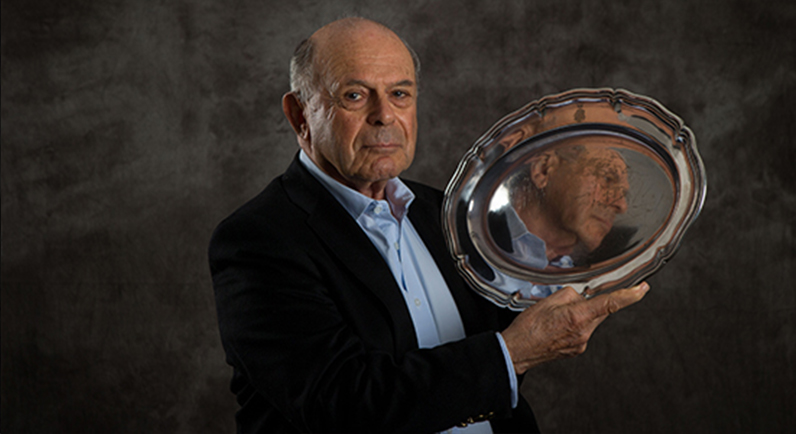
Survivor Portraits - Tom Fleming

Survivor Portraits – Tom Fleming

Survivor Portraits – Tom Fleming (1938 – 2025)

This month we introduce Tom Fleming. Tom was born in 1938 in Bratislava, Czechoslovakia.

With a twinkle in his eye and a mischievous grin on his face, you could still see the six-year-old boy that Tom once was. Tommi was independent, confident, and a little naughty. These characteristics became more pronounced once he was imprisoned in Theresienstadt. He took up a dare to pin a ‘tail’ on an SS officer, played tricks on other child inmates and often suffered profound consequences after such misdemeanours.

Tom remembered the oppressive rules, the changing cast of prisoners, the brutality of the camp guards, and most vividly, the time when he was forced into a burial pit and ordered to spread lime over corpses. Despite the daily terror, he knew the exact day of his most distressing moment in Theresienstadt: 16 February 1945. This day was seared into his memory because when he awoke on that day, his mother Lolli, who had been a source of comfort and protection, had vanished. He knew what disappearance meant, but he was too young to know that his mother was pregnant and had been taken to the hospital to deliver another son, Peter. Of the 350 children born in Theresienstadt, his brother would be one of 25 to survive.

Towards the end of May 1945, a few weeks after liberation, Tom returned to Bratislava with his mother and brother to wait for the return of his father. It would take months before news would reach them confirming that his father, along with many other family members, was murdered in Auschwitz.

Etched into Tom’s personalty was a spirit of adventure and playfulness, despite the pain and sadness he beared from the past. He learned at a tender age about the precariousness of life, and he intended to make the most of it.

In this photograph, Tom holds a silver serving platter containing the family crest, salvaged from the family castle in Slovakia.

To read more from our Survivor Portraits blog series, click here.

To explore the personal stories and anecdotes of Holocaust survivors, click here for our first online exhibition.

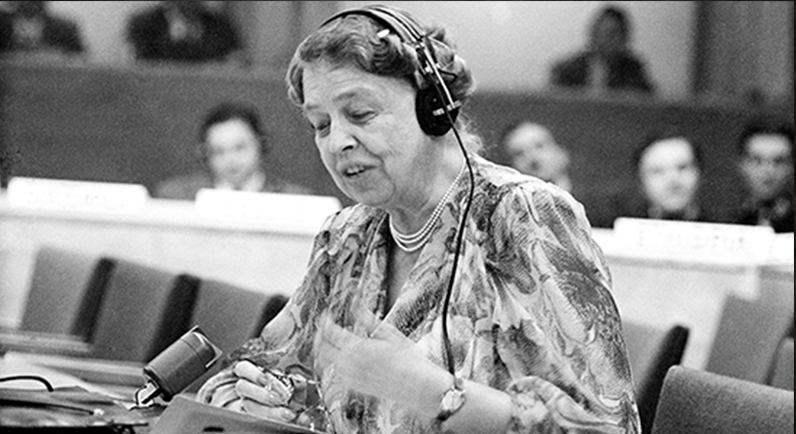
A Profile of Eleanor Roosevelt

A Profile of Eleanor Roosevelt

A Profile of Eleanor Roosevelt

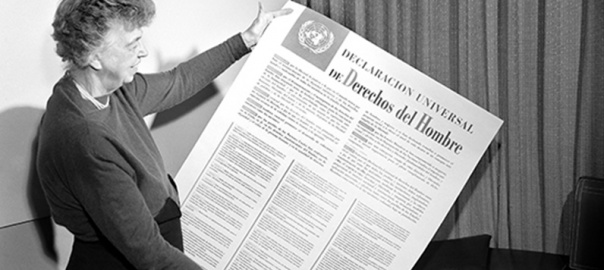
Eleanor Roosevelt – wife of President Franklin D. Roosevelt –  was an outspoken public figure in her own right.  Fiercely independent, she was an author, humanitarian, and champion of diverse social causes who helped draft the 1948 Universal Declaration of Human Rights.

Not content to stay confined to domestic issues — and unafraid to ruffle the feathers of the many critics who complained that she was overstepping her role — she held her own press conferences, wrote her own newspaper column, travelled abroad to support American troops during World War II, and frequently spoke out on issues of women’s rights, children’s issues, helping the poor, and combating racial discrimination. Following the death of her husband, she served as a delegate to the United Nations General Assembly and became chair of the Human Rights Commission where she contributed to the Universal Declaration of Human Rights – the most widely recognised statements of the rights of all.

The Declaration serves as a yardstick to measure government performance by organisations and governments all over the world, but is not binding. It has influenced the constitutions and legislation of many countries. It has had far reaching influences on treaties around the world.

Although Mrs. Roosevelt was proud of her role in shaping the Universal Declaration, she was always a realist. She knew its words were not self-enforcing. The real challenge, she liked to tell United Nations delegates in later years, was one of ”actually living and working in our countries for freedom and justice for each human being.”

That is a challenge she readily accepted, and her example is one that inspires us today.


Author: Sandy Hollis, Education Officer

Shavuot

A rare coincidence – Shavuot

A rare coincidence – Shavuot

Did you know that Shavuot is the only biblical festival that does not have a specific date prescribed in the Torah? Instead, the Torah merely instructs that Shavuot must fall on the fiftieth day “after Shabbat”.

But which Shabbat?

There are two different schools of thought. One holds that that this refers to the first Shabbat of Pesach, while another holds that it refers to the first day of Pesach itself (which is like a Shabbat, as it is a day of rest).

Those in the first group mark Shavuot on a different calendar date every year, but always on a Sunday, since a Sunday will always be the fiftieth day after a Shabbat. Those in the second group celebrate the festival on the 6th day of the Hebrew month of Sivan, since this is always the fiftieth day after the first day of Pesach.

Whilst once an irresolvable calendrical dilemma that divided pilgrims’ celebrations, Jewish law now designates that Shavuot falls on the 6th of Sivan. Sivan is a spring month in the Hebrew lunar calendar, which tends to coincide with the Gregorian months of May or June.

This year, we find ourselves at a rare juncture. Since the first day of Pesach fell on a Shabbat, the 6th of Sivan also falls on a Sunday. Although it is not a major concern for Jews these days, this rare event might symbolise the uniting of different customs in the celebration of one of the most important Jewish festivals.

Justice in Australia - A special visitor

Justice in Australia – A special visitor

Justice in Australia – A special visitor

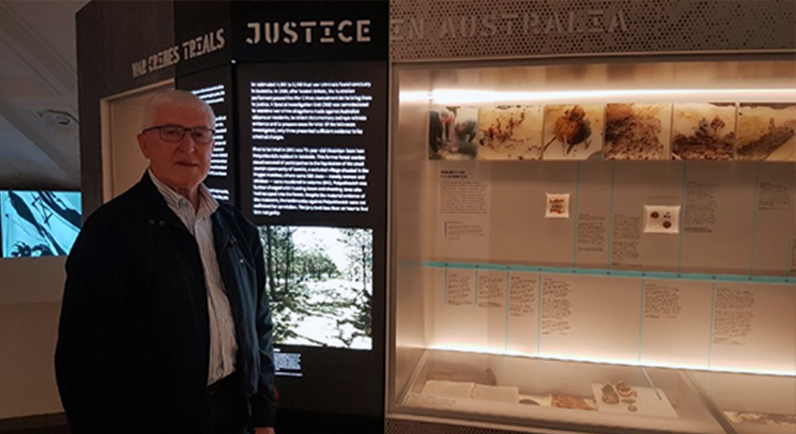
Recently, a visitor to the Sydney Jewish Museum revealed that he had worked as a Senior Investigator for the Special Investigations Unit of the Federal Attorney-General’s Department, which was set up to investigate war criminals residing in Australia following World War II.

It has been estimated that between 4,000 and 5,000 war criminals found sanctuary in Australia after WWII. The Special Investigations Unit (SIU) was commissioned during the 1980s to examine war allegations made against Australian citizens or residents, and to collect documentary and eye-witness evidence and prepare cases for trial.

Robert Gray, who worked in the SIU from 1987 to 1989, said he was incredibly moved during his visit to the Museum. Of particular impact on him was the ‘Justice in Australia’ exhibit, which displays the unearthing of a mass grave in Serniki in eastern Poland.

In August 1987, Robert Gray accompanied the late Bob Greenwood Q.C. (Head of the SIU) to Israel, the former Soviet Union, the United States of America, and West Germany. The purpose of their visit was to bring attention to those governments about Australia’s resolve to investigate allegations of war crimes and, where appropriate, lay charges. The seven-country tour received press in Australian Jewish media. On his visit to the Museum, Gray brought with him a copy of Vic Alhadeff’s article in the Australian Jewish News from August 1987, entitled ‘Investigator to visit Russia, Israel and US: Australia’s official search for evidence on war criminals’.

Robert met the Museum’s Resident Historian, Konrad Kwiet, who was appointed as Chief Historian at the Australian War Crimes Trials shortly after Robert left his position.

Robert mentioned several times how emotional he felt during his visit to the Museum, particularly following his meeting with Holocaust survivor, Jack Meister, who survived Radom Labour Camp, Auschwitz, Auschwitz Buna Prison Camp and Buchenwald Concentration Camp.

Stanisława Leszczyńska

Did You Know: The Polish Catholic midwife of Auschwitz

Did You Know: The Polish Catholic midwife of Auschwitz

Did You Know? Polish Catholic midwife Stanisława Leszczyńska delivered 3,000 babies in Auschwitz from 1940-1945.

Stanisława Leszczyńska was born in Lodz, Poland, living in relative peace until the Nazi of Poland. Prior to the occupation she studied midwifery, married and started a family.

Under Nazi occupation a ghetto was established in Lodz, the Jewish population being forced to live in squalid conditions. Stanisława and her family decided to aid the Jewish population living in the Lodz ghetto by smuggling in food and false Aryan papers.

In 1943, the Leszczyńska family were discovered, Stanisława being sent to Auschwitz along with her daughter. In Auschwitz, Stanisława managed to reveal that she was a midwife by smuggling in her occupation papers in a tube of toothpaste, and she was subsequently assigned to the maternity ward.

Stanisława Leszczyńska

Many pregnant women who arrived at Auschwitz were sent straight to their death and those women who became pregnant in the camp were often quickly executed and or given forced abortions. For women who were admitted to the maternity ward, they gave birth in squalid conditions and generally children were quickly drowned. A small selection of children born were taken out of the camp and assigned to Aryan families as part of the Lebensborn program.

Stanisława refused to take part in the killing of children despite threats from those around her working in the ward. Stanisława went forward caring for the mothers before, during, and after their labour with compassion. Of the 3000 deliveries performed by Stanisława, all of the mothers and children survived the birth. Stanisława created a sense of safety in the ward, and the camp more broadly; the prisoners called her  “mommy” and “the angel of goodness.” Liberated at Auschwitz, Stanisława returned to midwifery, after the war.

"It’s just what is in your heart”

“It’s just what is in your heart”

“It’s just what is in your heart”

Recently, a visitor to the Museum reminded us, and Holocaust survivor Olga Horak, of the importance of sharing poignant stories of suffering and survival with younger generations.

Some months after the Museum’s 25th birthday event, an envelope arrived at the Museum for Olga from a gentleman who attended the event. This gentleman had spent some time with Olga at the celebrations, and he and his daughters had listened to Olga and learnt about her experiences during and after the Holocaust.

Despite the passage of time after their meeting, the poignancy of Olga’s story of survival was not dulled for this gentleman. Some weeks after this encounter, a touching two-page letter addressed to Olga was delivered to the Museum, accompanied by a delicately engraved, heart-shaped gold locket holding photographs of Olga’s family inside.

In his letter, the gentleman expressed his wish to send some small reminder of what is truly important in life: “It’s not a house, it’s certainly not a car – it’s just what is in your heart.”

Survivor Portraits - Francine Lazarus

Survivor Portraits – Francine Lazarus

Survivor Portraits – Francine Lazarus (1938 – 2026)

Holocaust survivor Francine Lazarus was born in 1938 in Ixelles, 2 years before the Nazis invaded Belgium.

Belgium was invaded on 10 May 1940, after horrendous stories of Nazi terror towards Jews in occupied countries had already begun filtering through. In Belgium, the Nazis enforced the registration of Jews. No registration meant no food coupons, but registration meant it was easy to find and arrest Jews.

The round-up of Jews began in earnest in 1942. Francine was 4 when her father left her with strangers on a farm and disappeared. Distraught, frightened, and lonely, Francine cried for days. She was relatively safe and had enough food for some time. But eventually, the farmers were caught by the Gestapo, and Francine returned to Brussels. Walking with her father, hearing the heavy footsteps of boots, they hid in a doorway, Francine enveloped in her father’s big black coat.

Francine moved from safe house to safe house. Her clothes became too small, her shoes too tight. She received clothes from the older children, and passed hers on, although riddled with lice. Francine had to hide in a dark cupboard and remain incredibly still, despite the itch from the louse bites.

Francine’s father was caught and sent on the last convoy from Belgium on 31 July 1944, and was subsequently murdered in Auschwitz. The only remaining tangible memory of her father is his ring that Francine still holds onto.

After liberation, not able or willing to care for her, Francine’s mother sent her to foster care. She was intractable and naughty, and she would often be thrown out. Her needs for love and affection were not met here. Francine only began school when she was 8 years old, and finished before she turned 14. Her mother remarried in 1948, and gave birth to Francine’s half-sister, whom Francine had to care for, at the age of 11.

In 1959, Francine left Belgium, arriving in Sydney, Australia, by ship. Francine described the vista upon her arrival: “Coming through the Heads, I saw this beautiful place bathed in sunshine. I had found my harbour.”

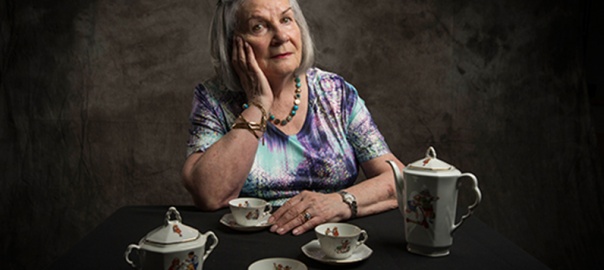
This coffee set occupied Francine’s time whilst she was in hiding, and became a way for her to imagine that she was entertaining other children and eating imaginary biscuits. Her coffee set is on display in the Sydney Jewish Museum.

To read more from our Survivor Portraits blog series, click here.

To explore the personal stories and anecdotes of Holocaust survivors, click here for our first online exhibition.

To read Francine’s biography, you can purchase a copy of A Hidden Child from Belgium here.

Photograph by Katherine Griffiths.

On the Ship that Launched a Nation

On the Ship that Launched a Nation

On the Ship that Launched a Nation

When our curators delved into the Museum archive to select some of the most intriguing, unexpected objects in the collection for our current temporary exhibition, Unseen Untold: Our Curious Collection, they came across some that didn’t make the cut but were too interesting not to share on our blog.

Here is a snippet from our ‘Director’s Cut’:

Following the Second World War millions of people were displaced from their homes. For the survivors of the Holocaust, returning to life as it had been was impossible. Antisemitism and the haunting memories of their destroyed communities forced them to look afar. There were few options for emigration and little regard for their plight. Homeless survivors languished in Displaced Person Camps for years.

Jewish survivors increasingly looked to Zionism; their nationalism was heightened by lack of autonomy in the camps and having few destinations available to them. The British government, which controlled Palestine, refused to let large numbers of Jews in. Illegal immigration, the Brihah (Hebrew for flight or escape) was the only option.

Esther Starzynski had fled her home in Poland only to be interned in Siberia. Released several years later, she travelled to Georgia, hoping to go through Turkey to Palestine. She married and her young family made their way back to Europe dreaming of finding another route to Palestine.

In 1947 Esther, her husband, and two children secured places on the Exodus, a ship with over 4,500 illegal immigrants hoping to get to Palestine. Most of the emigrants were Holocaust survivors without the necessary migration documents. Esther bought this suitcase to carry their few belongings on the trip.

Like many before, the British intercepted the ship. But the passengers resisted. Ultimately, the British took the refugees to Hamburg, Germany, and forcibly returned them to DP camps. The ship’s ordeals made international headlines and caused the British government much public embarrassment. Attitudes to the plight of Holocaust survivors began to change, increasing international pressure on Great Britain to allow free Jewish immigration to Palestine.  The family eventually made it to Palestine, where they settled near Haifa.

Author: Shannon Biederman, Curator

Anzac Day - A day of remembrance

Anzac Day – A day of remembrance

Anzac Day – A day of remembrance

Anzac Day is a day of remembrance in Australia and New Zealand, that honours those who served and died in wars and conflicts.

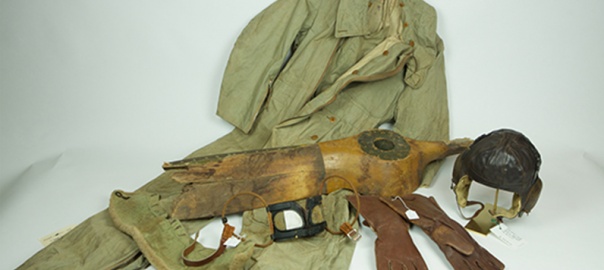
In our current exhibition, Unseen Untold: Our Curious Collection, we have on display a broken wooden propeller that belonged to Edward Alexander Lane’s plane that he crashed on the grounds of Mascot Golf Club in 1938. Whilst flying did not bring Lane the success he desired, the remainder of his collection held by the Museum is reflective of his more successful military career in the Royal Australian Navy.

Lane enlisted on 12 June 1919 into the British Merchant Navy, which brought him the following year to Australia. Lane met his future wife whilst he was serving on the HMS Sydney. They married in 1925 under Jewish and civil law.

At the outbreak of World War II, Lane was prompted to join the Australian Navy as Chief Petty Officer. Despite having a booming business at the time, Lane left his family for his military service, off the back of a comment from an acquaintance that “Jews don’t fight”. Lane was shipped to England and transferred into the British Royal Navy, where the joined the British Fleet Arm, flying combat missions off carrier ships.

Lane’s service was physically demanding, and was not without its mishaps. At one point, Edward accidentally landed a plane in a field in France in incredibly foggy conditions and was temporarily grounded. Lane was also permanently deafened in one ear from a pistol being fired at his side by a fellow officer. Lane’s family attested that he certainly sustained some psychological effects from his service, experiencing bouts of depression whilst a Lieutenant in England and upon returning to Australia in the mid-1940s.

Whilst involved in the war efforts of World War II, Lane was apparently not aware of what was happening to the Jews of Europe. In the many letters that he sent to his family between 1941 and 1945, there was no mention of these matters. His determination to fight the Germans was based more on his loyalty to the ‘Empire’ than an obligation to European Jewry.

Yom HaShoah - We Remember

Yom HaShoah – We Remember

Yom HaShoah – We Remember

This week, we commemorated Yom HaShoah and remember the victims of the Holocaust.

Every day the education team at the Sydney Jewish Museum facilitates conversations between Holocaust survivors and school students. In every interaction, survivors recall the loved ones lost during the Shoah. In speaking their names, and bringing them into their thoughts, they bring them back for that moment they are held in their minds. They share these names with thousands of Australian students and pass on their memories. In doing so, they also pass on the responsibility of memory to the next generation and to the wider Australian community. Their memories make Holocaust history personal and relevant in the world today.

On Yom HaShoah we also commemorate acts of heroism. It is the anniversary of the Warsaw Ghetto uprising, an event that has become emblematic of the strength and bravery of Jewish communities persecuted by the Nazis and heir collaborators. It is in this spirit that we also acknowledge the ongoing and unwavering contribution that Holocaust survivors and their families make at the Sydney Jewish Museum. Every survivor who speaks, recalls memories that are painful. They relive some of their most difficult moments, sometimes at significant personal cost. This act of sharing testimony is an incredible act of resistance. We know that these stories were never meant to be heard. That the Nazis intended no survivors to make it to this point to have their voices heard. By speaking to students in the museum, they continue to show incredible strength and bravery, naming the crimes and making them visible and personal.

For the memories of those who were killed, and the strength of those who survived and share their painful stories, We Remember.

Author: Dr Rebecca Kummerfeld, Head of Education

Chamber pot

Toilet humour

Toilet humour

Hitler’s black ‘toothbrush’ moustache is an easily identifiable feature of this dictator’s face. Numerous cartoonists satirise his distinctive features. David Low, a prominent New Zealand political cartoonist and caricaturist living in the United Kingdom earned fame for his merciless satirising of German dictator Adolf Hitler, Italian dictator Benito Mussolini and other leaders of the time. His depictions of Hitler and Mussolini led to his work being banned in Germany and Italy and being named in The Black Book – the list of those the Nazis planned to arrest in the aftermath of an invasion of Great Britain.

Recently, a visitor to the Museum donated a souvenir that is a good example of toilet humour dealing with a serious matter. It is a miniature ashtray in the form of a chamber pot, designed to revenge the German invasion of Poland. Inscribed ‘Flip your ashes on old nasty’, it invites the user to stub out a cigarette on the face of Hitler. But the shape of a chamber pot invites one to symbolically do more: empty ones bowels on Hitler. The caricature of Hitler inside the pot is the work of David Low.

The chamber pot contains all the ingredients of anti-German propaganda, starting with ‘Jerry’, the traditional nickname for Germans and a common term for a potty. Mocking Hitler was common in Britain during the 1930s and early in the war, but satirical propaganda such as this became less common as the seriousness of Hitler’s actions became apparent and death tolls increased as the war progressed. As Charlie Chaplin later said, their crimes were too immense for comedy.

This propaganda ashtray was produced in the period between the invasion of Poland in September 1939 and the Battle of Bardia in January 1941. Although widely imitated, the originals, like this example, were made by Fieldings of England.

They were always regarded as being in bad taste and cheeky, but the public loved them.

Author: Roslyn Sugarman, Head Curator

Survivor Portraits – Egon Sonnenschein

Survivor Portraits – Egon Sonnenschein

This month we introduce Egon Sonnenschein. Egon was born in 1930 in Ptuj, Yugoslavia.

Egon came of age as a fugitive. The softly spoken individual was a child of 10 when Germany attacked Yugoslavia in April 1941 and his life on the run began.

The family fled to his grandparents in Croatia, a puppet Nazi state run by the brutal Ustashi, whose cruelty was on par with the most abominable regimes of the past. Victims of the Ustashi’s sadistic rule were impaled, burned alive, and tied together and then drowned. The brutality and murders Egon witnessed remain ingrained in his memory to this day.

The Sonnenscheins survived thanks to the generosity of the town Mayor, a former student of Egon’s grandfather, who saved over 300 Jews and Serbs from death.

Desperate to leave Croatia for Italian-occupied Slovenia, the family purchased false identity papers from a Slovenian man who offered to take their household goods to his country, issuing a false contact address to aid their border crossing.

The family arrived, weary and fearful. Despite paying a large sum for help, they had no permits to enter the country and were imprisoned for five weeks. Upon his release, Egon’s father went to collect their household goods and exchanged Italian liras with the “helpful Slovenian man”. During the exchange, Egon’s father noticed his own beautiful carpet laid out on the floor, realising that the plan had been to have the Sonnenscheins killed, and steal their belongings.

In 1943, the family moved again. Crossing Lake Como and struggling up mountains, they finally made it to Switzerland, where they discovered friendship and people willing to help. Egon was entrusted to the care of a foster family. To this day, he remains in touch with the children and grandchildren of the family who, he reflects, “treated me better than their own children.”

After the war the Sonnenscheins left communist Yugoslavia, living in Israel for seven years, and after that in South Africa for 26 years. In 1983 Egon, his wife Miriam and their four children immigrated to Australia.

In this photo, Egon exhibits a postcard intended for his aunt Regina Grunfeld. Dated 11 April 1943, it is stamped ‘Otputovao Parti’ (Departed – Return to Sender). Some items belonging to Egon are currently on display in the Sydney Jewish Museum.

To read more from our Survivor Portraits blog series, click here.

To explore the personal stories and anecdotes of Holocaust survivors, click here for our first online exhibition.

To read Egon’s memoir, Sunshine, Memory and the Healing of Time, you can purchase a copy here.


Photograph by Katherine Griffiths.

Judaica with an Australian twist

Judaica with an Australian twist is rare to come by

Judaica with an Australian twist is rare to come by

With Pesach around the corner, the Sydney Jewish Museum is excited to have acquired a rare and possibly unique item of Judaica for the collection: a ‘Seder’ (Passover) plate. Purchased through a grant from the Australiana Society, this plate has joined our relatively small collection of Australian-made Judaica objects in the Museum archive.

The plate, in the shape of a six-pointed Star of David, was hand-made by Vande Pottery, a Sydney commercial pottery that operated until 1958, and it is the only one that we know of to date.

The pottery was originally established in Mosman in the early 1950s. It was purchased by Samuel Vandesluis, an English migrant with Dutch-Jewish heritage, who renamed it ‘Vande Pottery’. Samuel Vandesluis recognised the opportunity for producing Australian pottery and concentrated on the growing demand for souvenirs, or ‘Australiana’.

In addition to the thousands of wall plaques, ashtrays, dishes and platters that Vande produced, they also designed some one-off pieces which could be placed in the fine art category. All were hand-painted and many of the decorators came from East Sydney Technical College. Vandesluis appreciated his designers, allowing his craftsmen to add their signatures to the pieces they made.

Of particular note to us were the two decorators employed at Vande who could write Hebrew. Marlene Adams decorated and signed this Seder plate. She used gold paint to mark the placement of the ritual food items – salt water, bitter herbs, parsley, lettuce, haroseth (a mixture of chopped apple, nuts and wine to symbolise bricks and mortar), egg and shankbone. These foods are significant to the ritual retelling of the Exodus from Egypt, and are symbolic of freedom from oppression and slavery.

As the Museum continues to stumble upon unique and local representations of the ancient culture of Judaism, discoveries of objects like this Australian-made Seder plate reminds us that in a democratic country like Australia, we should always be grateful for our religious freedom.

Author: Roslyn Sugarman, Head Curator

Ruby Rich, a pioneering Jewish feminist

Ruby Rich, a pioneering Jewish feminist

Ruby Rich, a pioneering Jewish feminist

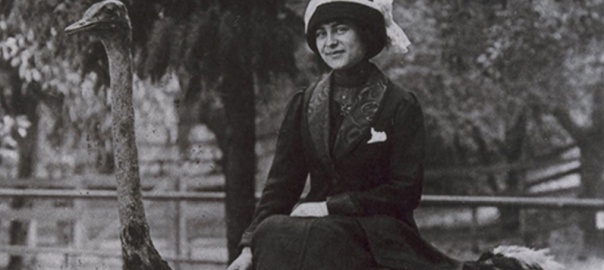
To celebrate International Women’s Day, we are celebrating a Jewish feminist who was active decades before Australia’s Women’s Liberation Movement of the 1960s and 1970s. Ruby Rich came from a wealthy Jewish family. Yet, despite her protected childhood, or perhaps because of it, Ruby rebelled. A gifted concert pianist, Ruby wanted to make her music her career. Her father was outraged: “Ladies did not pursue a career”, but finally he relented slightly and in 1907 took her abroad to finish her education.

In England, Ruby was introduced to feminist ideas, but these interests were interrupted by compulsory volunteer work during World War I. Back home in the 1920s, Ruby founded Australia’s first birth control clinic and became a member of the Racial Hygiene Association – later renamed the Family Planning Association – and devoted fifty years to these causes. In fact, the group’s original name led to its investigation by national security in the 1940s, as it was thought to have overtones of antisemitism, which could not be further from the truth. For different reasons the Association nevertheless shocked many. Its original aims were to educate people about venereal disease; to have the need for sex education recognised; and to work generally in the field of eugenics.

The links established between the Jewish and non-Jewish feminists in the 1920s through the 1940s, led them to work together on many issues of equality, and Ruby Rich became associated with the fight for equality for women. She was a Member of the First Council for Action for equal pay in 1929. She fought for women becoming members of Parliament regardless of their politics, believing that the presence of a woman was all that really mattered. In 1922 she was the campaign secretary to Millicent Preston-Stanley, who sought election to Parliament. This campaign failed but Preston-Stanley later became the third woman to be elected to Parliament in Australia and the first in New South Wales. Later, Ruby Rich became associated with feminist Jessie Street and acted as Jessie’s campaign manager when she ran for Parliament, albeit unsuccessfully, in the 1940s as part of the Women for Canberra movement.

Ruby Rich married Dr Maurice Schalit later in life and became involved in various Zionist causes, sharing this with her husband who had previously lived in Palestine. In 1936, before her marriage, Ruby founded the Australian Friends of Hebrew University, and in 1937 she was elected as WIZO’s first Federal President, a position which she retained for three years. Ruby never stopped working for a variety of women’s organizations. In 1980, at the age of 92, she established a halfway house for women released from prison. In 1967, Ruby was awarded the MBE and in 1975 she was awarded the United Nations Peace Medal. The Anzac Peace Prize followed in 1987.

Ruby died in 1988, one month before her 100th birthday.


Image: Archive of Australian Judaica (detail)


Survivor Portraits - Helena (Lena) Goldstein

Survivor Portraits – Helena (Lena) Goldstein

Survivor Portraits – Helena (Lena) Goldstein (1919-2019)

This month we introduce Helena (Lena) Goldstein. Lena was born in 1919 in Lublin, Poland. She was moved to the Warsaw ghetto, from which she eventually escaped.

Lena was recruited by the resistance movement in the Warsaw ghetto to fight against the Germans in any way she could, and assisted fellow Jews in the struggle for survival. Lena stole uniforms and light bulbs, which were filled with kerosene and used as Molotov cocktails against German troops.

Following her escape from the ghetto in 1943, Lena was hidden by a Polish caretaker for 18 months. Later, her hiding spot was an underground bunker, cramped together with eight others in a space that allowed no privacy. The psychological struggle of this experience  was unbearable, and yet, Lena penned a satirical newsletter to bolster the morale of her bunker companions, who threatened to leave as conditions were so deplorable. This outward humour masked the true nature of her anxieties. Her personal diary entries from this time reflect the gravity of her struggle.


Thursday, 16 November 1944

“I long for the splatter of autumn rain. I long for the monotonous music of raindrops beating with fine drizzle against the window pane, for the grey, melancholy, clouded November sky. And I long for the thoughts: thoughts at twilight hour, the thoughts which, sad as they might be, never begin with the words ‘If I survive…’, and never carry the burden of doubt that all this thinking is empty and pointless, because…I will not survive anyway…”

Lena was liberated in January 1945, after spending 6 months in the bunker. She married Alexander Goldstein and immigrated to Australia in 1949.

In this photo, Lena holds her German ID card identifying her as a washerwoman in a laundry. On display in the Museum is Lena’s diary, which she kept during her time hiding in the bunker.

To read more from our Survivor Portraits blog series, click here.

To explore the personal stories and anecdotes of Holocaust survivors, click here for our first online exhibition.

Lena’s story is featured in the book We Are Here: Talking with Australia’s Oldest Holocaust Survivors. To purchase a copy of the book, click here.


Photograph by Katherine Griffiths.

The modern day Haman and an ironic remnant

The modern day Haman and an ironic remnant

The modern day Haman and an ironic remnant

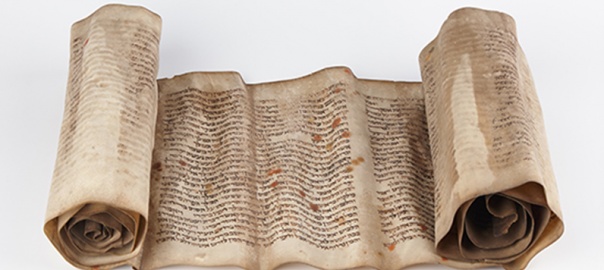
Visitors to the Museum may notice a damaged scroll in a cabinet next to our Kristallnacht display. What might the relationship be between the destruction of Jewish homes and property and this ancient text?

The scroll of Esther contains a story that tells of a genocidal campaign waged over two thousand years before the word “genocide” was to belatedly enter the English language. The viceroy Haman, second-in-command to the Persian emperor himself, embarks on a mission to eradicate the Jews in over one hundred provinces: from India in the east, to Ethiopia in the Persian empire’s west.

Scholars have long debated whether or not this story really happened. Its main characters, outside of the Hebrew Bible, are not attested in the historical record – leastways, not be the names that they are called within this particular scroll. And whether believable or not as a narrative, the way that it is constructed would testify to its being a well-crafted (and thoroughly deliberated) piece of literature.

For some two thousand years, the story of Esther and her cousin Mordekhai has excited and inspired Jews around the world. The festival of Purim, on which we celebrate the termination of Haman’s evil plans and the salvation of the Jewish people, remains to this day an occasion for feasting and great celebration.

In 1938, the genocidal campaign on which the Nazis had embarked was in full swing. They were two years shy of enacting policies that would allow for the widespread murder of Jews throughout their sphere of influence, but through a mix of violence and intimidation, and through the increasing pressure of legislation that was designed to marginalise and isolate Jewish communities within the Reich, the cultural eradication of Jewish life was well under way.

For the first time in all of Jewish history, the story related in the book of Esther was about to be enacted. For the first time, despite a long history of intermittent persecution, a government was going to exercise its unprecedented ability to completely eradicate the Jewish people of Europe. Only this would not be the story of Esther and Mordekhai. This story would not result in salvation for the Jews and a turning of the tables for their erstwhile oppressors. In this story, Haman would win.

In November of 1938, while synagogues throughout Germany and Austria were burning, untold numbers of Germans watched, unable to intervene. The stories of individual acts of heroism and resistance (both on the part of German civilians and police officers) is inspiring, but more striking is their paucity. By 1938, the state had thoroughly repressed all possibilities of anti-Nazi sentiment. By 1938, the German concentration camps had already been operating for five long years, many of their inmates being Germans who dared speak out against their government.

Amongst the various artefacts salvaged from burning synagogues at this time is a scroll of Esther. We do not know who rescued it, nor even whether or not they were Jewish. Damaged in parts to the point of illegibility, it nonetheless survives as a mute witness to the horrors of the period. Its content is starkly ironic: where the scroll speaks of a genocidal campaign averted, the scroll’s damage testifies to a genocidal campaign that succeeded. And yet, the very real possibility that it was a non-Jewish German who saved this scroll reminds us of how little we know about the thoughts and opinions of ordinary people at this critical time.

Author: Simon Holloway, Education Officer

“Man’s desire for peace lies behind this Declaration.”

“Man’s desire for peace lies behind this Declaration.”

“Man’s desire for peace lies behind this Declaration.”

“Man’s desire for peace lies behind this Declaration. The realisation that the flagrant violation of human rights by Nazi and Fascist countries sowed the seeds of the last world war has supplied the impetus for the work which brings us to the moment of achievement today.”
– Eleanor Roosevelt, 10 December 1948

Born in part from the need to implement a legal framework around human rights following the genocidal crimes of the Nazis, the Universal Declaration of Human Rights was proclaimed in 1948.

Three years after the end of World War II, the Declaration was presented by the United Nations General Assembly in Paris on 10 December 1948. The document presents the standards of fundamental human rights that are to be universally protected; its key promises translated into over 500 languages. This document was passed alongside the Convention on the Prevention and Punishment of Genocide.

Although a positive step towards the protection of the inalienable rights of individuals, races, ethnicities and religions, these enactments by the UN come under criticism as the world has, since 1948, continued to witness heinous crimes.

The Declaration is, in fact, non-binding and excludes important groups of rights holders, such as indigenous peoples. The Convention does not cover population expulsions, cultural genocide, or persecution of political groups. As well, neither of these documents seriously inhibits state sovereignty.

So whilst Eleanor Roosevelt’s words on 10 December 1948 are poignant and inspiring, it is our duty to revisit human rights history, and the successes and challenges of its legislation, 70 years later. As a people who ourselves have been vulnerable, it is our duty to care about others when they are vulnerable, too.

The Sydney Jewish Museum’s new permanent exhibition, The Holocaust and Human Rights, takes as its starting point this crucial moment in human rights history, for both its successes and its major pitfalls. Australian Human Rights Commissioner Edward Santow expressed, at the launch of the new exhibition, the very urgency that the world felt in 1948 for a new way of organising itself, and a similar urgency today that for every violation there is a triumph or a victory for human rights and for dignity of all humans.

Image: UN Photo

Survivor Portraits - George Grojnowski

Survivor Portraits – George Grojnowski

Survivor Portraits – George Grojnowski (1927 – 2021)

This month, we introduce Holocaust survivor George Grojnowski. George was born in Radziejow, Poland, in 1927, and was incarcerated in Radziejow Ghetto, Czestochowa Ghetto, Rakow Labour Camp and Buchenwald during the course of WWII.

A crucial part of George’s story that he felt necessary to pass on was the glimmer of humanity that he found in two encounters with Nazi guards, to which, in part, he attributed his survival. George recounted his first encounter; a Nazi guard stopped him from running to his mother and sister who, subsequently, went directly to their deaths. The second was when a guard delivered George back to his father – a symbol of value for human life amidst absolute bleakness.

After liberation on a Death March to Theresienstadt, George moved to Australia in 1949; it is this day that George considered his true birthday. It wasn’t until much later, when George’s wife prompted him to talk about his experiences, that he formally began to tell his story.

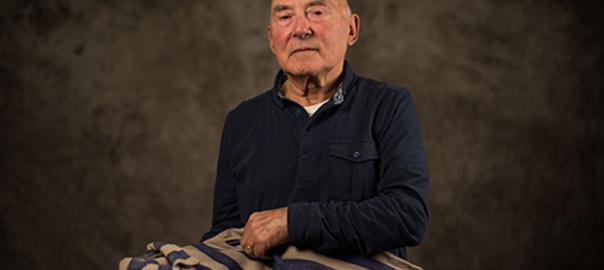
In this photograph, George is pictured with the concentration camp jacket he wore in Buchenwald, on which he changed the yellow triangle to red in gratitude to his Soviet liberators.

To read more from our Survivor Portraits blog series, click here.

To explore the personal stories and anecdotes of Holocaust survivors, click here for our first online exhibition.


Photograph by Katherine Griffiths.

A Tribute to Mala Sonnabend

A Tribute to Mala Sonnabend

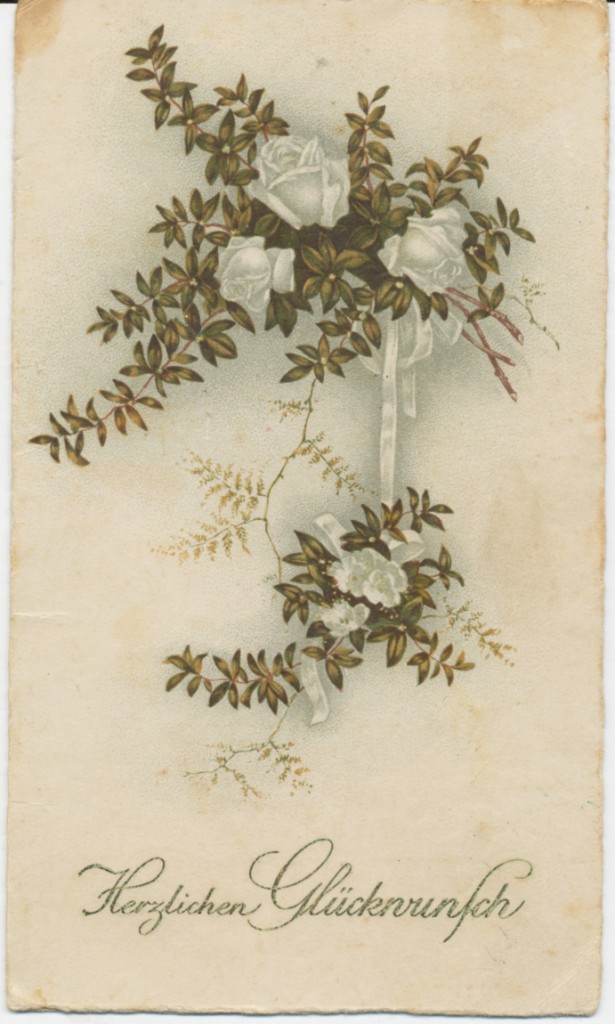
This weekend we commemorate the UN International Holocaust Remembrance Day and the Liberation of Auschwitz. To remember Holocaust survivor Mala Sonnabend, who was liberated from Auschwitz II-Birkenau and recently passed away, we are sharing this card, inscribed with Herzlichen Glucknrinsch – Hearty Congratulations, which Mala received from the Russian soldier who liberated her on 3 May 1945. This treasured object in the collection was on display in the Museum for many years, and currently lives in our archive.

Mala was born in 1918 in Ostrolenka, Poland. Germany invaded Poland when she was 21 years old, in 1939. Mala was subsequently incarcerated in the Bialystok ghetto and Stutthof, Auschwitz, Ravensbruck, Malchow and Auschwitz II-Birkenau concentration camps.

After escaping a Death March, Mala hid in a barn with two other girls until, three days later, they were brought to the safety of a local house by a Russian soldier. This soldier found this greeting card in the home and inscribed it to Mala: “In memory of the Liberation from the German slavery to a girl from Poland, Mala Rekant, from the liberator Sergei Kislakov.”

On her experience of liberation, Mala once recalled: “Elated! After coming out of hiding and seeing a Russian soldier, who said ‘You are free’, I fell to my knees. I had to be picked up. I couldn’t stand – I’d starved for several days.”

Conservation

Material evidence

Material evidence

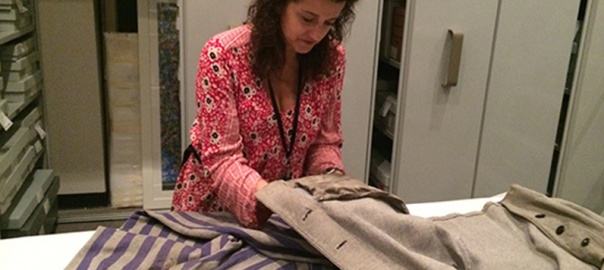
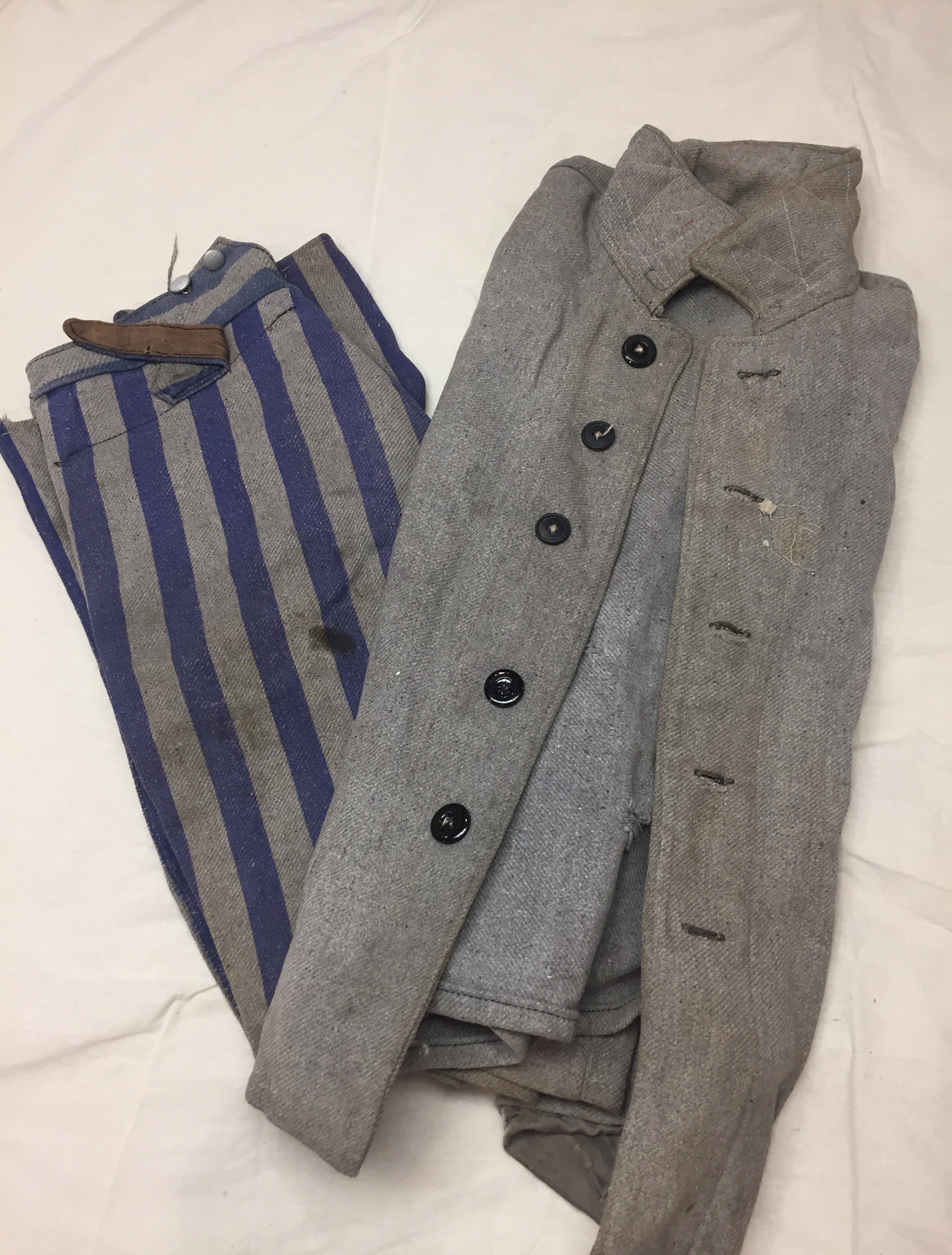
Last month, Dr Sofia Pantouvaki, Professor of Costume Design, Aalto University, Helsinki visited the Sydney Jewish Museum. She met with survivors and viewed our collection of concentration camp garments. Her ongoing research examines clothing from concentration and labour camps during World War II, investigating the material evidence together with the testimony of survivors. Whilst the most familiar and recognisable type of camp clothing is the striped uniform, an array of other garments, including civilian clothing marked in specific ways, was used to identify camp inmates.

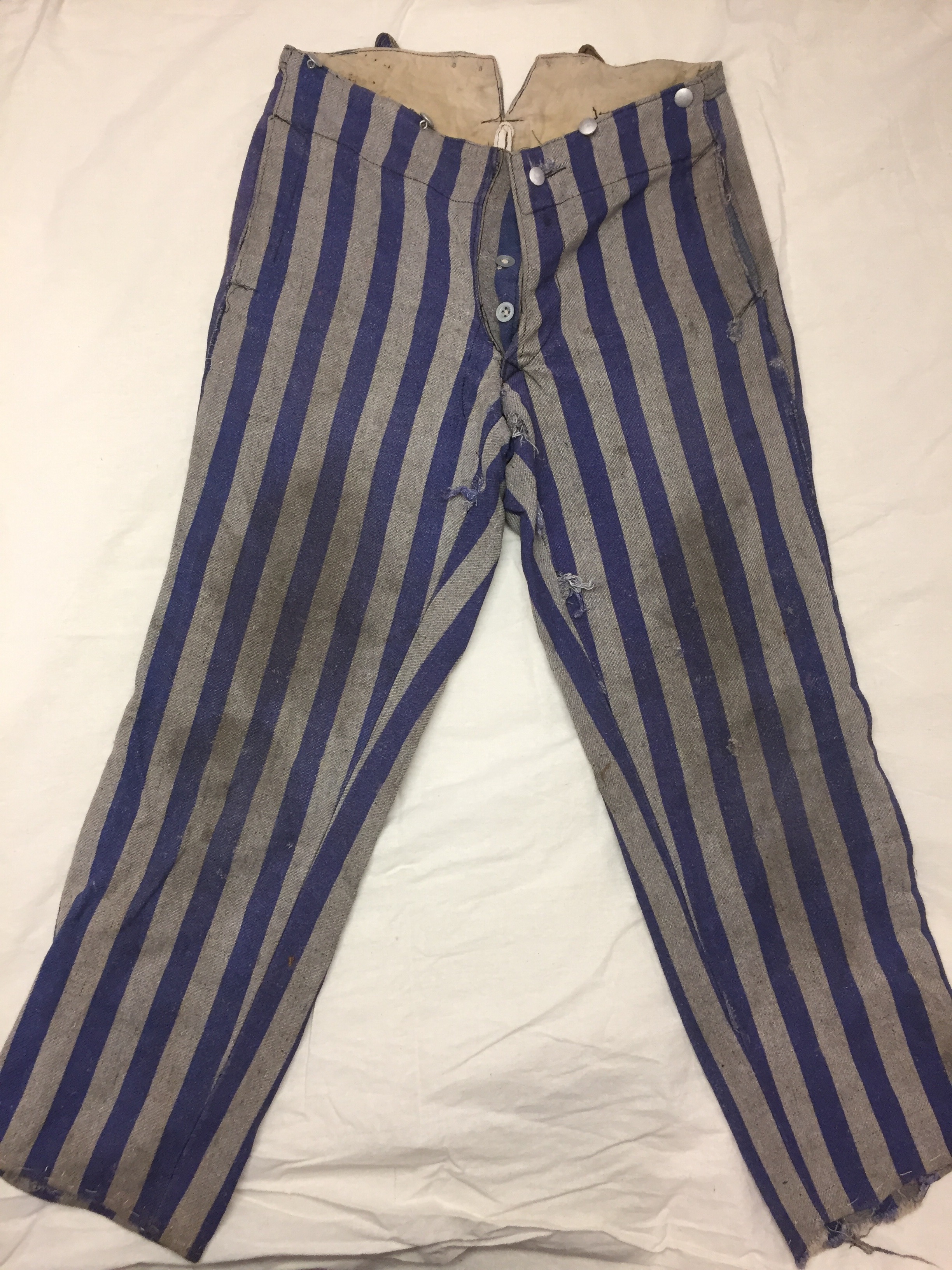
Sofia was enthusiastic to view a recent acquisition to our collection, that of an Auschwitz camp uniform with striped trousers and a non-matching plain grey fabric jacket. In opening the collection up to an expert eye, I was delighted that Sofia was able to identify another garment in our collection that we have always regarded as a dress – due to its length – as a coat!

In these images you can see Sofia examining items of camp clothing while Kathleen Szabo, a costume researcher, is measuring the garments in order to make patterns of their cut. Using these patterns the researcher will compare garments from different camps and trace their provenance.

Author: Roslyn Sugarman, Head Curator

Survivor Portraits - Paul (Pavel) Drexler

Survivor Portraits – Paul Drexler

Survivor Portraits – Paul Drexler

At the beginning of every month we introduce to you one of the Museum’s treasured Holocaust survivors’ stories.

This month, we are featuring Paul Drexler. Born in 1938 in Spacince, Slovakia, Paul was in hiding until 1944, when, at the age of 6, he was deported to Theresienstadt.

In September 1944, during the final round-up of Slovak Jews, Paul’s family was ordered by the Nazis to report to the authorities for resettlement. Even as a young boy, Paul could feel the palpable tension, and that his parents were really afraid.

In order to borrow time, Paul and his family went into hiding in a farmhouse outside the village, paying a large sum of money for the privilege. Paul and his family were there for two and a half months until their names were read on the local radio. The announcement read that anyone harbouring the Drexler family would be executed. The Drexlers were forced to go home, and, within 24 hours, they were arrested by the Gestapo. They were taken to a transit camp in Slovakia called Sered. It was here, in December 1944, that Paul saw his father for he last time.

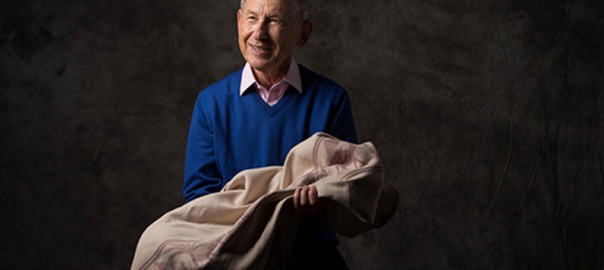
Two weeks later, Paul and his mother were packed into a cramped cattle train heading to Auschwitz. By a stroke of luck, the train was diverted to Theresienstadt. Paul and his mother were liberated in May 1945, and immigrated to Australia in 1948.

The cashmere blanket that Paul cradles in this portrait was purchased for him when we was 3 by his father. This blanket, with its interesting frieze depicting a man leading a camel through the desert, kept Paul warm and comforted by loss throughout his internment. Paul’s blanket is on display in the Sydney Jewish Museum alongside his story.

To read more from our Survivor Portraits blog series, click here.

To explore the personal stories and anecdotes of Holocaust survivors, click here for our first online exhibition.

To read Paul’s memoir, In Search of My Father, you can purchase a copy here.


Photograph by Katherine Griffiths.

The sinister banknote

The sinister banknote

The sinister banknote

Education Officer and Currency Aficionado, Simon Holloway, lets you in on some facts about one of the world’s lesser known, and incredibly short-lived, currencies.

Focusing on the currency issued by the Nazis in Theresienstadt, Simon explains that several of the ghettos and concentrations camps in operation as part of the Third Reich had Nazi-issued local currencies in circulation. The main purposes of these currencies were to defraud the population of cash and goods and, in so doing, create a false sense of stability amongst inmates. Money sent to inmates, as well as valuable personal effects, were exchanged by the SS for the local currency, which inmates could use only amongst themselves in their own micro-economy.

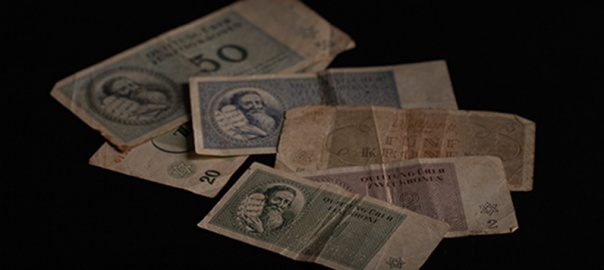
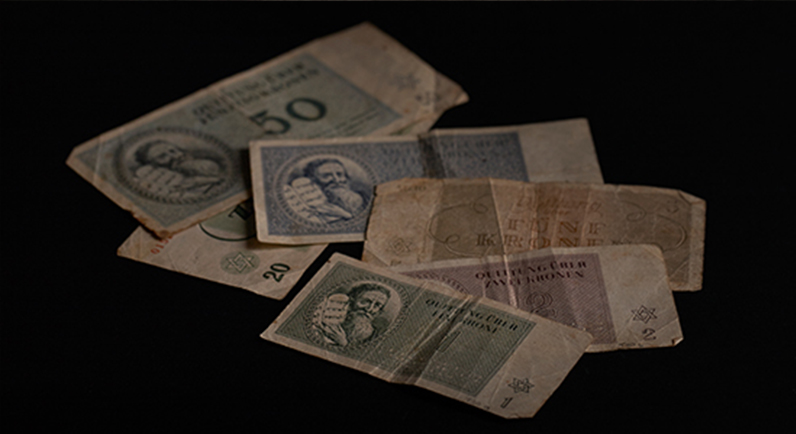
The Nazis issued local banknotes in the Theresienstadt concentration camp in mid-April 1943; the currency was referred to as the ‘Crown’. The notes themselves featured a lavish and thoroughly Jewish-themed design: a classically ‘Semitic’ profile of Moses holding the Ten Commandments, and the signature of Jakob Edelstein, the Elder of the Jews in Theresienstadt.

Their design tells us that not only were the banknotes lulling inmates into oblivion about their fate, but that they served a propagandistic purpose. Nazis were able to prove to bodies such as the International Red Cross how comfortable life was for Jews in this camp. This was communicated by means of a propaganda film made on-site (although never screened), and by allowing the Red Cross access into the actual camp.

In fact, the overwhelming majority of the population of Theresienstadt was murdered, including Jakob Edelstein, who was killed in Auschwitz in 1944.

People interned in Theresienstadt earned stipends of these Nazi-issued Crowns in the performance of their various jobs, and they were encouraged strongly to spend it. In actuality, there was virtually nothing that the money could be used for. Entering a café cost 5 Crowns, and consuming tea or coffee (both fakes, or ersatz) cost another 2 Crowns. Shops were erected in which people could purchase items confiscated from Jews when they entered Theresienstadt. However, the goods were priced so dearly that they were unattainable. Working men and women in relatively prominent positions, earned between 95 and 205 Crowns per month. As a result of the attainability of goods, the money never circulated. Borrowing books from the library cost a 50 Crown deposit, but since the money was effectively worthless, unable to give access to anything of real value, nobody ever bothered collecting their deposits back. By the end of the war, the Theresienstadt library had over 200,000 Crowns in uncollected deposits.

What is interesting when looking at the Theresienstadt banknotes on display in the Sydney Jewish Museum, is the near-pristine, mint condition of the paper notes. This is very telling of their existence as a vehicle for propaganda rather than an economic tool, and goes further to explain how there are so many notes that live in public and private collections today.

Tracing the roots of Greek Jewry

Tracing the roots of Greek Jewry

Tracing the roots of Greek Jewry

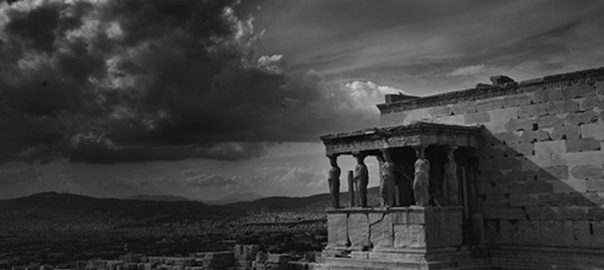
Our current Temporary Exhibition, The Jews of Greece, tells the rich and little-known story of Greek Jewry through photography and documentary film. Here is a little bit of background reading to catch you up on an ancient snippet of the past two and a half centuries of Jews living in Greece through the ages. This post will take you on a journey from the first century BCE through to the end of the Byzantine Empire.

We know from records dating back to the first century that during this time Jews lived in Greece, and that the Greek and Jewish communities shared similar sets of values and ideas relating to their approach to social conduct and humanism, among other things. So integrated into Hellenistic life, we find evidence of this symbiotic relationship in translations of the Old Testament from Ancient Hebrew into Greek from as early as 270 BCE.

With the Roman conquering of the Greek Empire and Jerusalem between 146 BCE and 70 CE, the Jewish community in Greece became larger and more established as the region was reshaped to include yet more Jews in the greater region. These Jews became known as Romaniotes. They adopted distinct practices and a unique dialect of the Greek language, Yevanic.

Flash forward to 395 CE, when Christianity was introduced by Constantine the Great and the Byzantine Empire was established. The enforcement of religious conversions under the Byzantine Romans made it difficult for Jews to uphold their traditions. Although their efforts to enforce conversions were non-violent (in comparison to anti-Jewish persecution that we see later in history), some Byzantine emperors imposed special Jewish taxes, and various religious heads often used using anti-Jewish rhetoric to emphasise the new prevailing Christian ideologies. Nonetheless, Romaniote Jewish communities kept a stronghold in Greece.

The Ottomans moved in on Byzantine Greece in the 14th century. Whilst Greece was busy struggling (and succeeding) to prevail for autonomy over the following 5 centuries, Jews continued to consolidate a centre for themselves in Greece: in the port city of Thessaloniki. During this time, Jews were being expelled from Spain and Portugal, and so began a wave of Sephardi Jews descending upon Ottoman Greece, and, at least for a little while, the religious practices and economic contributions of Romaniote and Sephardi Jews were welcomed.

The Modern Greek state has yet more ideological ebbs and flows of which to tell. From the Greek War of Independence in 1821 through Nazi Occupation during WWII, the very real story of a unique Jewish culture under pressure continues to unravel.

"...no trace of Rudi"

“…no trace of Rudi”

“…no trace of Rudi”

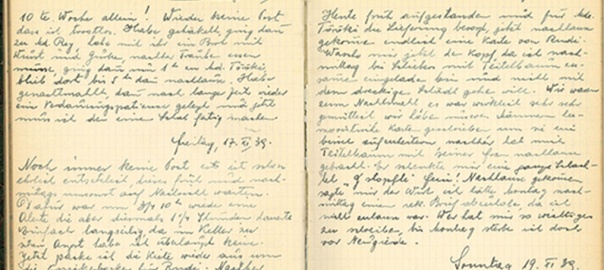
Every object tells a different story. Recently the Museum accessioned a diary which was penned by Holocaust survivor Elisabeth Epstein (nee Steiner). Those who knew her best, referred to her affectionately as Tante Elly (Aunt Elly).

This intimate record written in Paris, September 1939 to July 1940, portrays Elisabeth’s frustrations and fears over the imprisonment of her husband Rudolph (Rudi) Epstein at the outbreak of WWII. Interned as an enemy alien, Elisabeth visits Rudi twice after his arrest and then loses track of his location for 10 months as he is moved from camp to camp. Her diary entries communicate her increasing sense of despair.

“… no trace of Rudi and the disappointment cannot be described, none of them knew where Rudi went from Toulouse; I howled like a watchdog and sent cards in all directions”

Her final entry is the day they are reunited in Lyon, but the end of their “bitter separation” as she writes, is ultimately bitter sweet. In the months following, both Elisabeth and Rudi are arrested and sent to concentration camps. Rudi is murdered in 1943.


Author: Rachel Mensforth, Curator of Collections

Survivor Portraits - Jacqueline Dale (nee Feldman)

Survivor Portraits – Jacqueline Dale

Survivor Portraits – Jacqueline Dale

At the beginning of every month we will be featuring a treasured Holocaust survivors’ story.

This month, we introduce Jacqueline Dale (nee Feldman). Born in 1931 in Paris, Jacqueline was hidden in an orphanage from 1942, at the age of 11, until liberation.

Jacqueline’s father thought that despite being Jewish, because of his family’s position in Paris and his service in the French military, the Nazis would not intern him. Nonetheless, he was deported in 1941, and sent to Auschwitz in 1942. Jacqueline was 11 years old and her brother was 5 when her father was taken away. This, Jacqueline explains, was the start of her life as a child survivor.

When it became clear that Jacqueline and her brother’s lives were in danger, they left Paris to a Catholic orphanage on the Spanish border. The only person who knew that they were Jewish was the Principal, and they were able to stay at the orphanage, and participate in the Catholic curricular activities, until the end of the war in 1945.

It wasn’t until 50 years after the war ended, in 1995, when Jacqueline publicly addressed her childhood experiences, in a Spielberg interview for the Shoah Foundation.

Jacqueline volunteers at the Sydney Jewish Museum, and finds it a useful place of memorial for her father, her grandparents, and extended family, all of whom were killed by the Nazis.

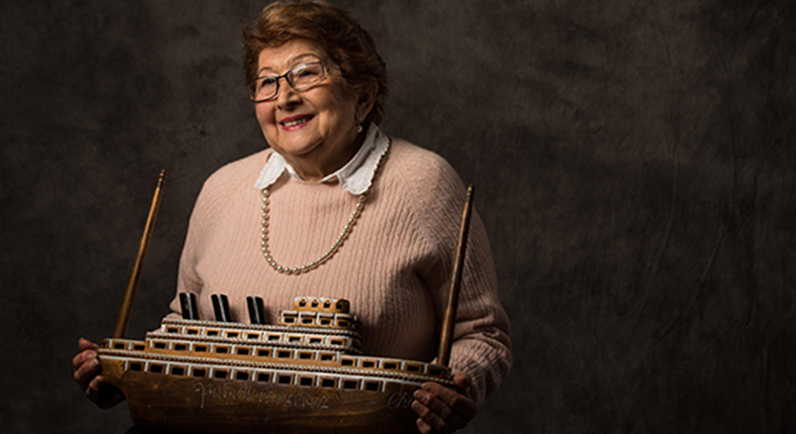
The wooden passenger ship that Jacqueline holds was carved by her father while he was being held in the Pithiviers internment camp in France, 1941/42. This object is on display at the Museum alongside Jacqueline’s story.

To read more from our Survivor Portraits blog series, click here.

To explore the personal stories and anecdotes of Holocaust survivors, click here for our first online exhibition.

To read a story for young readers based on Jacqueline’s wartime experiences, you can purchase a copy of Goodbye Maman here.

Photograph by Katherine Griffiths.

Celebrating 25 years

Celebrating 25 years

Celebrating 25 years

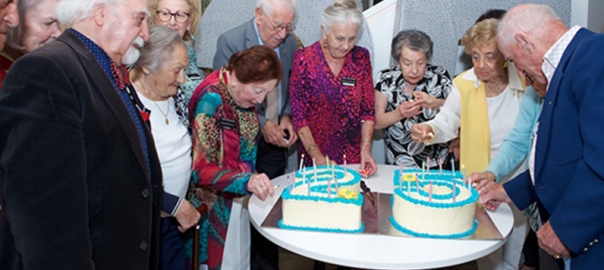
Saturday 18 November marked the Sydney Jewish Museum’s momentous 25th birthday. Moving into our 26th year, we are taking some time to reflect upon the formative years of the Museum, and the incredible pioneering spirit of the Holocaust survivors so central to the Museum’s existence and relevance today.

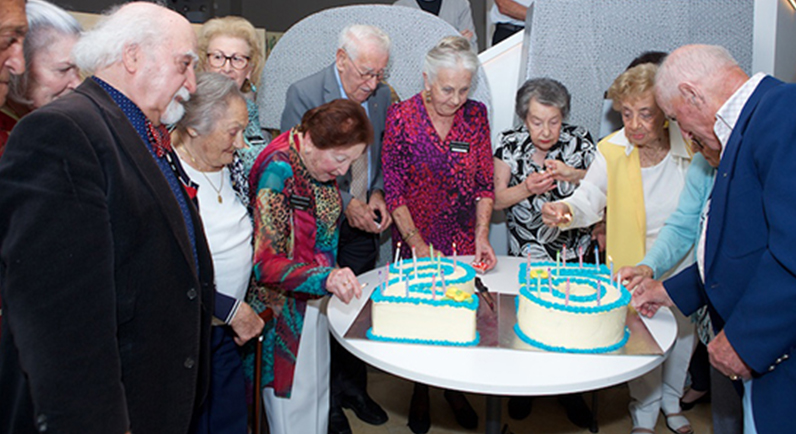
On Sunday 19 November, nearly 30 survivors assembled in the Magen David foyer of the Museum around blue-and-white iced cake in the shape of ‘25’, to mark the tremendous achievements of their peers in growing and nurturing the seed that they planted 25 years ago.

On this occasion, Norman Seligman, CEO of the Sydney Jewish Museum, offers: “As we celebrate our 25th anniversary, it is important to remember the driving forces that gave rise to our creation. One such force was a desire by the generation of Holocaust survivors who came to Australia. They were determined to remember and honour those who were murdered during the Holocaust. Even before the Museum opened in 1992, they had been meeting, telling their stories and gathering artefacts.”

Hundreds attended the opening of the Museum on Wednesday 18 November 1992. It was an emotional event that signified the realisation of a long-anticipated and hard-earned dream for the survivor community. They finally had a single place at which to remember, commemorate and pass on the important messages of the Holocaust, particularly for those who were never able to.
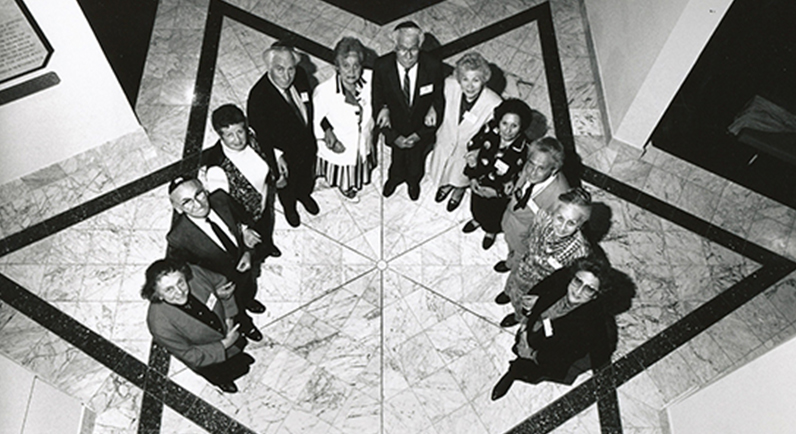
The release of Steven Spielberg’s film Schindler’s List in 1994 brought the Holocaust into the Australian conscience, and the Museum experienced an influx of visitors wanting to learn more about this history.

Another key landmark event in the Museum’s history, and one of many more significant anniversaries to come, was the 50th Anniversary of Liberation in 1995. This year was highlighted by a tribute evening at the Sydney Opera House with talks by liberators, survivors and descendants. It was in this year, as well, that The Resource Centre was opened by former Prime Minister Bob Hawke AC GCL.

Securing its future as a longstanding feature of the Australian Jewish community, in 1998 the Sydney Jewish Museum formed a Committee of Management and became the 18th member of the Jewish Communal Appeal.

In 1999, the Museum opened Within the Walls: The Theresienstadt Ghetto, the first major temporary exhibition since 1996, and the Museum’s first travelling exhibition.

In the year 2000, the Museum launched Project 120, the video-recording of Survivor Guides’ testimonies for preservation of their stories. The turn of the century marked an emphasised focus on history and memory, and the importance of personal story to understanding the Holocaust.

A destination within the Museum, the Children’s Memorial was opened in 2002. Each year since its dedication, photographs are added to the Memorial’s wall to continue the representation of community voices.

The 60th Anniversary of Liberation was celebrated in 2005 and, with this milestone, brought the record-setting student visitor attendance to 12,000.

The Museum acquired nearly 600 objects from the NSW Association of Jewish Ex-Servicemen and Women in 2007, which substantiated the Museum’s collection on Australian Jewish History. In 2010, the Museum took measures to showcase this collection in its new permanent exhibition space with the opening of Serving Australia: Jewish Contribution in Australian Military History.

Garnering much fanfare, Dressing Sydney: The Jewish Fashion Story was opened in 2012. In this same year, the Curatorial Department was successful in procuring its first loan from the Auschwitz Birkenau State Museum, Poland.

From 2015 to the present, the Museum has continued to grow into newly refurbished education and exhibition spaces with world class technologies for research and display of testimonies and artefacts. In 2017, after nearly 5 years of development, the Museum opened the new permanent Holocaust Exhibition, which will continue to allow visitors to engage with Holocaust history in dynamic ways, through new technologies and previously archived artefacts. Now educating more than 25,000 students and welcoming over 23,000 adults per year, the Museum proudly continues to maintain its relevance and pass on its key messages to the generations to come.

Greetings for a sweet New Year

Greetings for a sweet New Year

The exchanging of Jewish New Year greetings goes back centuries. With the industrial revolution printing became inexpensive and entrepreneurs began selling cards printed specifically for Rosh Hashanah. These cards were intended to be short lived, to be discarded shortly after the high holy days, yet such ‘ephemera’ occasionally turn up in scrapbook and old photo albums. In the digital era, email cards are a quick solution for wishing friends and family a healthy and happy year to come and a hope to be inscribed in the Book of Life.

At the end of the war in 1945, between 60,000 and 80,000 Jewish Displaced Persons (DPs) in newly liberated Europe found refuge in displaced persons camps. These evolved into centres of regeneration, especially bolstered by the influx of 200,000 Jews who survived the war in the USSR. DPs celebrated Jewish festivals in an attempt to return to the normal rhythms of religious and communal life. Rosh Hashanah cards featuring the portraits of Holocaust survivors, together with often Zionist iconography and imagery proliferated as survivors began to search for loved ones and send New Year cards as a sign that they were alive.

The Sydney Jewish Museum has Rosh Hashanah cards from Ebelsberg and David Stern DP camps, Austria, donated by Max Schein (born Moniek Himmelschein). Max appears in two of the cards and an unknown survivor appears in the third. Zionism emerged as a prevailing force in these camps as Jews searched for a new life. Zionist iconography is plentiful on these New Year cards – a view of Jerusalem, a steamship carrying refugees to Israel and a flag of the newly formed Israel.

Having survived the war in Poland using false identities, 17-year-old Moniek Himmelschein returned to his hometown in Warsaw after the war to search for family but there was “Nothing left.” He lived in a DP camp for four years, was eventually reunited with his mother and a sister who returned from Russia, immigrating with them to Australia in December 1949.

Given his traumatic childhood and war time experiences, it is not surprising that Moniek is not smiling in the photographs of these happy New Year cards.

Author: Roslyn Sugarman, Head Curator

Can you spot a fake?

Can you spot a fake?

Can you spot a fake?

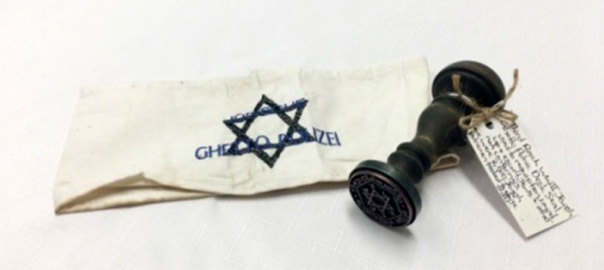
Star of David armband worn by ghetto police (fake) and Jewish ghetto police desk seal (fake)

If you were shopping in a market in Thailand and came across a cheap Kate Spade handbag, you would probably be right in thinking that the bag is a reproduction or a fake. When you can’t afford the real thing but you want it anyway, a fake is a good stand in.

But what when the fake is Holocaust related and how can you tell the difference between a fake and a real item from the Holocaust?

This question was brought home to me recently when a lovely man came in to the Sydney Jewish Museum to donate items that he purchased from an antique store in NSW, believing them to be Holocaust memorabilia.

As a curator in a history Museum I have a duty to ensure that what we collect and display is authentic. There is a difference between a fake and a replica – and that is intention. A fake is presented as an original object and is intended to mislead or deceive. A replica or facsimile on the other hand, is something the Museum supports in preserving our original material.

We get donations from the public who are unaware that they have purchased a fake and we also get donations from the public who wish to remove fakes from circulation to avoid any long term confusion with it being genuine. So we have decided to collect these fakes even though we will not formerly process them into the collection nor ever display them.

There is a proliferation of fakes on the market and we wish to spread the word to the public to be skeptical and to recognise the importance of provenance to the integrity of an artefact. The vast majority of our collection consists of artefacts donated directly by Holocaust survivors or their descendants and thus there is a direct link between the object, the survivor and the memory that goes along with it.

Fakes do not memorialise the Holocaust. Merchandising any aspect of the Holocaust serves no purpose other than to earn money from the suffering of others.

Author: Roslyn Sugarman, Head Curator

Holocaust survivor, society darling and acclaimed portrait artist

Holocaust survivor, society darling and acclaimed portrait artist

‘’I always say God paints the last brushstroke on my portraits, because I leave them to mature for a few weeks after I’ve finished them and when I come back to them, they seem to look different’’

The Museum recently received five paintings from the estate of acclaimed artist, Judy Cassab (1920-2015). Her work, represented in galleries and museums within Australia and internationally, is testament to the pioneering craft of a woman who defied the confines of gender and status, to reshape the art world in Australia.

Born Judit Kaszab in 1920 in Vienna, Austria, Judy was raised by her mother and grandmother in Beregszász, Hungary, where she studied art. She painted her first portrait at the age of 12 and went on to study art in Prague and at the Budapest Academy. Her studies were disrupted by Nazi occupation and her subsequent time in hiding, “…it was the first time in my life that I was not a girl, not a woman, not a human being, but a Jew”. Most of Judy’s immediate family was murdered in the Holocaust. In 1951, she migrated to Australia with her husband and two young sons.

Her first solo exhibition held at the Macquarie Galleries in Sydney in 1953 was the beginning of a long and celebrated career. Judy went on to win the Archibald twice, first in 1960 with a portrait of Stanislaus Rapotec and later in 1967 with the portrait of Margo Lewers. The awards and accolades continued into her later life.

Of the five pieces donated to the museum, four are portraits painted and drawn prior to the outbreak of World War II. Even in these formative years, Judy’s technical capabilities and her ability to capture the sitter’s ‘inner person’ as well as their likeness are evident.

Judy would go on to refine her portraiture into her early nineties. Painting for pleasure, her work was rendered complete, but not overworked or ‘finished’; she often added last minute touches described as the ‘vital marks which somehow pin one’s soul to the canvas’. Imbuing her portraits with an interpretive dimension, a specific element of her paintings were the subject’s eyes, which were always her starting point. She referenced this in her diaries, noting, “Whereas I probably wouldn’t place a highlight on a china cup, I mostly paint one in the eyes. It’s a magic moment when the eyes come alive and look back at me.” Both portraits of her parents seem to speak with their eyes, conveying the complexity of the relationship between parent and child.

Drawing of Anyu (Judy’s Mother)

‘The Morning Paper’, which features the artist’s husband, Jancsi Kampfner does not appear contrived or set up. There is something deeply personal in the work, capturing her subject in an ordinary, quiet moment at home; for a brief second the viewer is privy to the private world of the artist and perhaps the inner character of the sitter himself. Jancsi, a survivor of the Hungarian labour camps, encouraged Judy to embrace her work and channel her experience through her brush. Together they endured the hardships of war, migration and the inevitable ups and downs of marriage. Their love was enduring. Jancsi died in 2001.

Jancsi The Morning Paper

Judy was a pioneer; she balanced a family life and the demands of a public career, forging her place in a domain often reserved for men, casting aside her status as a migrant and the obvious deterrents in her path.

Author: Rachel Mensforth, Curator.

Holocaust objects and images

Save our history

Save our history

When the Museum opened nearly 25 years ago, the Holocaust Survivors initiated a collection of Holocaust related material by donating precious objects and images. These personal belongings provide the narrative of experience and witness accounts that pave the journey through the Museum’s exhibits. It was in the community’s best interest that we safeguard these items and their cultural heritage as they are a valuable resource to academics, historians and students. Objects are touchstones to personal stories and much is lost when the story comes second-hand. History should be preserved for future generations, once lost it cannot be recovered.

The Sydney Jewish Museum is now embarking on another collection drive to rescue Holocaust related material in the community. There is urgency to this collection as we want to speak to the original owner and record their experience first-hand.

A concern voiced is that people don’t want to donate items to have them ‘sit in a storeroom’. Museums generally only exhibit between 1-9% of their collection at any time. We endeavour to make our collection available to researchers and we are always using items from our collection for the numerous temporary exhibitions we curate.

You may think that you do not have anything of value or that your story is not interesting, but every piece of evidence is a crucial part of the historical record. Please don’t hesitate to contact Shannon in the Sydney Jewish Museum Curatorial Department on (02) 9360-7999 and help us save our history.

Holocaust objects and images

‘You have nothing to lose but your cultural cringe’

‘You have nothing to lose but your cultural cringe’

The Museum has recently acquired the first ever issue of POL, a cutting edge magazine which expressed the preoccupations of a generation of Australians. The acquisition is part of a concerted effort by Museum staff to preserve and recount the new lives forged by Holocaust survivors and the contribution they have made to the rich and multicultural fabric of Australian life.

For many Jewish immigrants, the fashion industry offered accessible opportunities for realising a new life, particularly if they were prepared to work hard, innovate and adapt. In addition, it was often easy to operate in the rag trade where language barriers were less acute. In the climate of a post-war Australia, the European influence of new immigrants was well received, shifting the country’s collective sensibilities and the cultural landscape of fashion.

POL Magazine. Museum Collection.

POL Magazine. Museum Collection.

In line with this maturing Australian awareness of style and expression, POL magazine emerged. Established by the controversial entrepreneur, Gareth Powell in 1969, the publication tapped into the radical spirit of its time. Adopting high production values and edgy editorial design, its fresh approach attracted an influx of progressive photographers and contributors.

Featured among the pages of the first issue is the Hibodress blouse factory, accompanied by an article which touts the rise of the see-through blouse. The article itself is a testament to the brand’s position at the fore of Australian fashion and the ingenuity of its founders.

POL Editorial. Courtesy Sydney Jewish Museum Collection

POL Editorial.  Museum Collection

The success of Hibodress, which was established two weeks after founders John and Olga Horak arrived in Australia, was multifaceted. John – a qualified textile engineer from the Czech Republic – worked alongside Olga who, despite no formal training, had an innate eye for fashion resulting in a bold line of wash-and-wear blouses.

Blouses from the Hibodress Factory. Museum Collection

Blouses from the Hibodress Factory. Museum Collection

While the Magazine was discontinued in 1986, its legacy is evident in both its experimental photography and challenging features.

During his tenure as the magazine’s editor, Don Dustan had this to say: ‘Pol delights in excellence, individuality, creativity and zest for life. We chronicle Australia’s maturity. We pursue the causes of the good. Australians of the world unite and read POL – you have nothing to lose but your cultural cringe’.

Authors: Rachael Mensforth, Curator and Natalia Thomas, Marketing Manager.

A pair of pants from Auschwitz

A pair of pants from Auschwitz

“It is amazing what treasures can be found sitting in the back shed or the garage*.

Today we received an extraordinary donation of an Auschwitz concentration camp jacket and pair of trousers – the latter represents the only camp trousers in our collection. They belonged to Wladzimierz Klunicki, a Polish man who fought with the partisans but was captured and sent to Auschwitz. He died in 1974 from kidney failure and other health problems resulting from his time in Auschwitz. He seldom spoke about his experiences.

FullSizeRender  FullSizeRender2

After arrival in the camp, those selected for work underwent the humiliating process of having their heads and bodies shaved. They were issued ill-fitting uniforms, registered and sent to the barracks.

At Auschwitz-Birkenau prisoners were also tattooed with a number. The donor, daughter of Wladzimierz Klunicki, recalls her father’s tattoo (which he later tattooed over with a heart) but does not remember the number.

While it may take some time to undertake further research about the man to whom the ‘uniform’ belonged, we can look to the artefact itself to discover its stories and secrets. The jacket is made of coarse cloth and consists of striped pants and plain, grey jacket. Not all prisoners received a striped uniform. Early prisoners in Auschwitz were given the tattered, unwashed military uniforms of murdered Soviet POWs, often encrusted with blood.

FullSizeRender3

Prisoners were stripped of their individual identities and referred to only by their registration number. This number, stencilled or drawn onto a strip of cloth, was attached to their clothing with a colour-coded triangle so the reason for incarceration was immediately recognisable. Remnants of the hand-stitching that held his registration number are still evident. The number however, is lost for now. On the inside of the jacket the wearer has crudely stitched a piece of fabric which has an opening at the top – clearly a resourceful way of adding an invisible pocket, in an otherwise pocket-less jacket. The camp trousers made of coarse grey and blue striped fabric, have been altered with a rough hem.

As custodians of this remarkable object, we will endeavour to research further and share its unfolding story.

(*Note to reader: shed or garage is not an ideal place to store precious memorabilia)

Author: Roslyn Sugarman, Head Curator

I need a hero…

“If a person destroys one life, it is as if they have destroyed the entire world. And if a person saves one life, it is as if they have saved an entire world.” – Mishnah Sanhedrin 4:5

All too often in times of change, anxiety and uncertainty humanity will give in to a base desire to find someone else, someone different to blame for our struggles. It is a phenomenon that finds root across cultures, faiths and generations.

The actions of the Righteous Among the Nations forces the question: under the same circumstances, how would we act? Would you risk death to shelter a child? Would you put the life of you and your family at risk to save, ten, one hundred, one thousand? If the world you knew crumbled around you, would you stay true to your faith? Would you waver from your moral compass?

egon

The Righteous Among the Nations are a testament to humanity. Atypical individuals who did not stand idly by in a time of fear, deprivation and destruction. Instead they nourished, sheltered and saved Jews in peril, because they deemed it right.

The bravery of the Righteous offers us a glimmer of hope. Through their deeds we see that we are not powerless in the face of ignorance and indifference. We do not have to be complicit in actions that defy our moral compass.

sugihara

The preservation of human life, human dignity and human rights is sacred. And by remembering their legacy and listening to their stories, we begin a journey that helps us to find our own voice.

Learn more about the Righteous Among the Nations here. Watch the exhibition trailer.