
Key information
Cost
Free for all students and teachers, supported by the Weiss Family
Dates
Thursday 26 November 2026 OR
Monday 30 November 2026 Time 9:30am to 2pm (4.5 hours) Capacity 200 students per day
Monday 30 November 2026 Time 9:30am to 2pm (4.5 hours) Capacity 200 students per day
About the program:
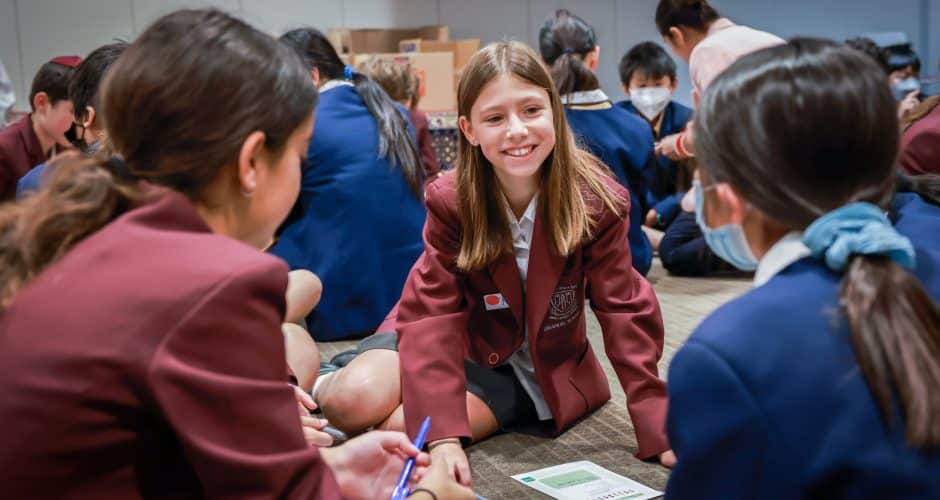
This program brings together Year 5 and Year 6 students from diverse cultures and backgrounds to spend a day engaging with each other in collaborative object-centred activities that focus on tolerance, friendship, optimism and intercultural understanding. Students will learn from Museum experts about how the Museum shares important intercultural and social lessons through objects and storytelling. Students will then turn to this task themselves, working with their new friends from different schools on an exhibition project, bringing objects and stories together to share an important message of their choice. This program allows students to discover the similarities that we all share, taking away critically important lessons with them into their future.
“Today I learned that… we are not different at all. I learned we are all human and should love each other. I really enjoyed coming here, and having the opportunity to see and learn about others.” – A previous student participant in the program
“Our children got so much out of meeting the other students and we loved hearing them explain their own artefacts, decide on themes, create their artworks and describe their work. They definitely came back to school buzzing!” – A previous School teacher in the program
Curriculum links:
PDHPE (Stage 3)
Outcome PD3-3
“evaluates the impact of empathy, inclusion and respect on themselves and others”
Intercultural Day requires students to listen to and engage respectfully with the experiences of others, providing authentic opportunities to demonstrate empathy, inclusion and respect.
Outcome PD3-10
“selects and uses interpersonal skills to interact respectfully with others to promote inclusion and build connections”
Students collaborate with peers from different schools and backgrounds, share personal stories and experiences, and work together to create a collective museum display.
Key Inquiry Question
“How does my uniqueness change over time?” and explore “social and environmental influences” on identity, including how “personal and cultural identity is shaped by their environment, including the influence of people and media.”
The object-sharing activity encourages students to reflect on the people, experiences, cultures and communities that contribute to their sense of identity.
Geography K-10 (Stage 3)
Key Inquiry: A Diverse and Connected World
“the diversity of people and cultures throughout the world” and examine “the world’s cultural diversity.”
Intercultural Day enables students to engage directly with the diverse cultural backgrounds, traditions and experiences represented within Australian communities.
Perspectives and Diversity
Students explore how connections shape perceptions and will have the ability to discuss “the effect of stereotypes and generalisations.”
Through hearing personal stories and engaging with meaningful cultural objects, students develop a more nuanced understanding of cultures and identities beyond stereotypes or assumptions.
Human Society and its Environment K-6 (2024)
Outcome HS3-GEO-01
“examines global citizenship”
By meeting and formation connection with young Australians from diverse religious and cultural groups, students will have the opportunity to wider their understanding of what it means to be a global citizen.
Learning Across the Curriculum – Intercultural Understanding
The syllabus identifies “Intercultural Understanding” as a key area of learning, supporting students to value cultural diversity and engage respectfully with others.
Intercultural Day provides a practical context for students to develop intercultural understanding through meaningful interaction with peers from diverse backgrounds.
Please complete the following expression of interest form below to be considered for this remarkable program.
For further information, please contact Erin O’Brien at eobrien@sjm.com.au, Mercedes Nitopi at mnitopi@sjm.com.au, or complete the following form:
Plan your visit
On the day
- Note that the museum has a substantial security presence. Your group may be asked to consent to a bag search.
What to bring
- Due to limited locker space, we request that students do not bring large backpacks.
- If the students plan to eat before or after their visit, please ask them to bring very small bags so that we can put several bags in each locker.
Access
- We strive to make our programs accessible and inclusive to students of all needs and abilities. Please advise us if you have any additional needs for your visit.
Content advice
- Note that the content covered at the museum may be distressing to some students.
- We recommend bringing your school councillor and/or members of your pastoral care team to the visit.
Payment
- An invoice will be sent after your visit, unless organised otherwise.
Confirmation of numbers
- All bookings must confirm any changes to student numbers at least 7 days prior to the visit in writing. Schools will be charged for the number of students we have on record 7 days prior to the visit.
Cancellations and booking changes
- Changes and cancellations including dates, times and student numbers must be made in writing.
- Each booking is permitted two changes at no cost. Each additional change over and above these two changes will incur a $30 administration fee.
- Cancellations made within 7 working days of the scheduled booking will be charged in full.
Risk assessment
Please click here for our risk assessment.
Pre and post visit lesson plans
Our Educators have created activities and resources for teachers to use to engage students before and after their visit to the Museum.
Complementary Programs and Resources
Understanding the Holocaust
FACE-TO-FACE
Introduce your students to studying the Holocaust. This program explores key historical events that contributed to this cataclysmic event unfolding.
Discovering Human RightsFACE-TO-FACE
Introduce your students to Human Rights, with a focus on some of the issues we see on our own doorstep, in Australia.
Children in a Vanishing WorldThis age-appropriate program will deepen students’ understanding of the historical context of these books and also speak to the themes that they raise about the rights of children and the complex ethical dilemmas that children faced during wartime.
What’s On Newsletter
Keep up to date on all Museum events and exhibitions.