
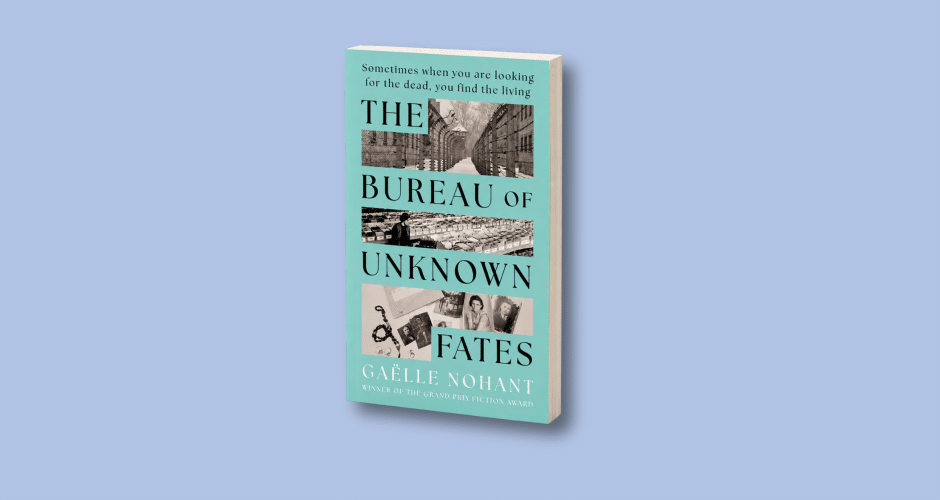
The Bureau of Unknown Fates: History, Memory and the Choices We Make
Fate suggests inevitability, that some things are simply meant to happen. But The Bureau of Unknown Fates is a story that leaves room for something more complicated; the possibility that our choices can alter what we think of as fate.
At the heart of this gripping novel is the International Tracing Service, now known as the Arolsen Archives.
The archives were created by Allied forces after World War II in 1947 to trace missing persons, document the fates of victims, and help survivors locate family members. It is also a place filled with objects; belongings confiscated from concentration camp prisoners and deposited there, waiting for someone to discover their stories.
This fictional story puts a young woman, Irene, at the centre of a search to discover the owners and stories behind three objects; a faded cloth puppet, a locket and an embroidered handkerchief which drive the main narrative. Small, ordinary objects that have somehow survived when the people who owned them did not.
When Irène joins the International Tracing Service, she becomes consumed by a desire to return these belongings to the families of their owners. In searching these stories, she is also trying to come to terms with her own past. Each object she holds is a clue, a way piecing together what happened to someone who was deliberately reduced to a number and a record.
What I found particularly compelling is the way the novel works on several levels.
There is the immediate story arc of the search driven by the objects and the people who owned them. Who were they? What happened to them? And, perhaps most importantly, do their families actually want to know? Is remembering always a gift, or can memory sometimes be something we choose to avoid?
Then there is the fictional background to the story in the context of the organisation itself, decisions made, information withheld and discoveries that were not always welcomed. There is a sense of a previous generation that did not necessarily want to let the past to be examined too closely. This puts Irène increasingly at odds and forces her to question what exactly her own mission should be.
As she searches for the dead, she is also working through her own emotional journey. The stories she uncovers inevitably become personal, and the boundary between her professional mission and her own understanding of memory and loss begins to blur.
I also liked the novel’s exploration of choice. The past may be fixed; we cannot change what happened, but the characters in the present still have choices to make.
The Bureau of Unknown Fates is of course a fictional story, but it is ultimately a story about memory and survival and about what happens when we are brave enough to look for the people behind the objects.
What’s On Newsletter
Keep up to date on all Museum events and exhibitions.