
Reading Masada: Between Archaeology and Imagination
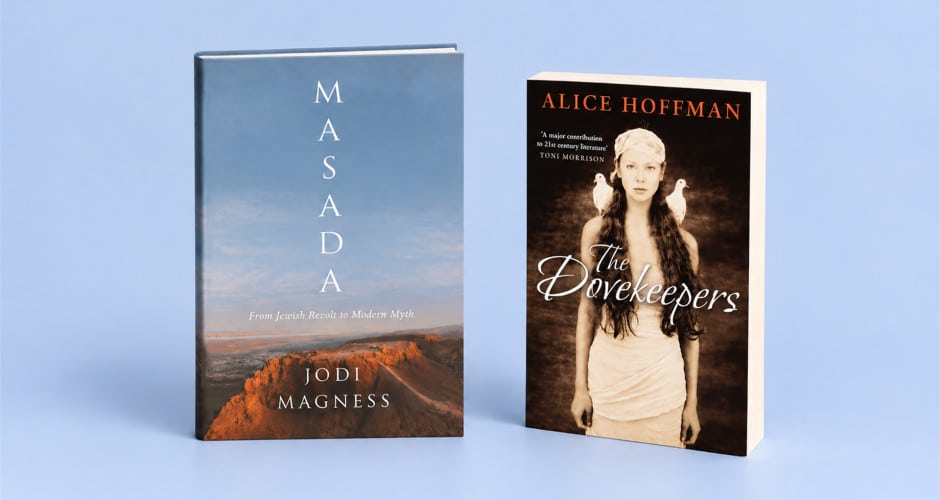
The Dovekeepers – Alice Hoffman | $22.99
The Dovekeepers is one of my favourite novels. I often speak about it to visitors, and then many share that is also one of theirs. In case you haven’t yet read though; the background history is that, in 70 C.E., nine hundred Jews held out for months against the Roman army on Masada, the isolated mountain fortress in the Judean desert.
According to Josephus, who left us the only contemporary witnessed account, only two women and five children survived. And out of this tragic event, Hoffman spins a spellbinding story of four extraordinary women, each of whom came to that point in time, to Masada by a different path.
From the book description:
- Yael’s mother died in childbirth, and her father, an expert assassin, never forgave her for that death.
- Rivka, a village baker’s wife, watched the horrifically brutal murder of her daughter by Roman soldiers; she brings her young grandsons to Masada, rendered mute by what they have witnessed.
- Aziza is a warrior’s daughter, raised as a boy, a fearless rider and an expert marksman who finds passion with a fellow soldier.
- Shirah, born in Alexandria, is wise in ancient magic and medicine, a woman with uncanny insight and power.
The lives of these four complex and fiercely independent women intersect in the desperate days of the siege. It’s one thing knowing the history, but a narrative like this breathes life into the tale and gives us a picture of the setting and its dramatic conclusion.
Masada: From Jewish Revolt to Modern Myth – Jodi Magness | $54.99
From fictionalised history to the real thing!
Inspired by The Dovekeepers by Alice Hoffman, I was intrigued when I saw this book available for the Museum Shop. I quickly ordered it, and, of course, purchased a copy for myself. I delved straight in, eager to discover what archaeological finds actually remain at Masada and what they can tell us about its history.
This is a meticulously researched academic work, and certainly not a quick read. I read it bit by bit, interspersed with other books. I always have more than one on the go, sometimes three or four!
Magness examines the historical accounts of the revolt, the siege and its aftermath, carefully weighing Josephus’ narrative against the archaeological evidence. Her conclusion is scientifically honest; archaeology that examines evidence left in stone cannot definitively establish whether a mass suicide took place. And yet, given the brutality of Roman warfare and the months spent by Roman soldiers and thousands of enslaved people constructing siege ramps around the fortress, the residual evidence almost two thousand years later, is clear and the possibility of that tragic final act remains entirely plausible.
What I found particularly fascinating was the evidence of everyday Jewish life on Masada. Magness explores the remains of buildings, cookware, food storage vessels and mikvah baths, making real this Jewish community whose existence was wiped out in its final days.
Scholarly and richly illustrated with photographs, this book offers a fascinating exploration of both the history and enduring story of Masada.
If you’ve already visited Masada or are planning a visit and want to understand the archaeological site beyond its iconic history, this book is well worth exploring.
What’s On Newsletter
Keep up to date on all Museum events and exhibitions.