

Incommon
Learn more about Jewish culture
INCOMMON is a new brand that has been designed to share the positive parts of Jewish culture. Because the more we have in common, the better our world is.
Here, we are sharing a deeper dive into the meanings behind the words and concepts we’ve used in the campaign. We love to see your curiosity about Jewish life, traditions and values, and we hope you will continue on this journey of discovery.
This information has been researched and written by the Sydney Jewish Museum’s expert team of educators, historians and curators.
Kiddush
Almost every festive occasion in Judaism – including Shabbat and festival meals, weddings, havdalah – commence with a blessing over wine or grape juice. This ceremonial blessing is known as kiddush (Hebrew word that translates to ‘sanctification’.
Many Jewish people own a special cup or goblet for kiddush, but it is not a requirement.
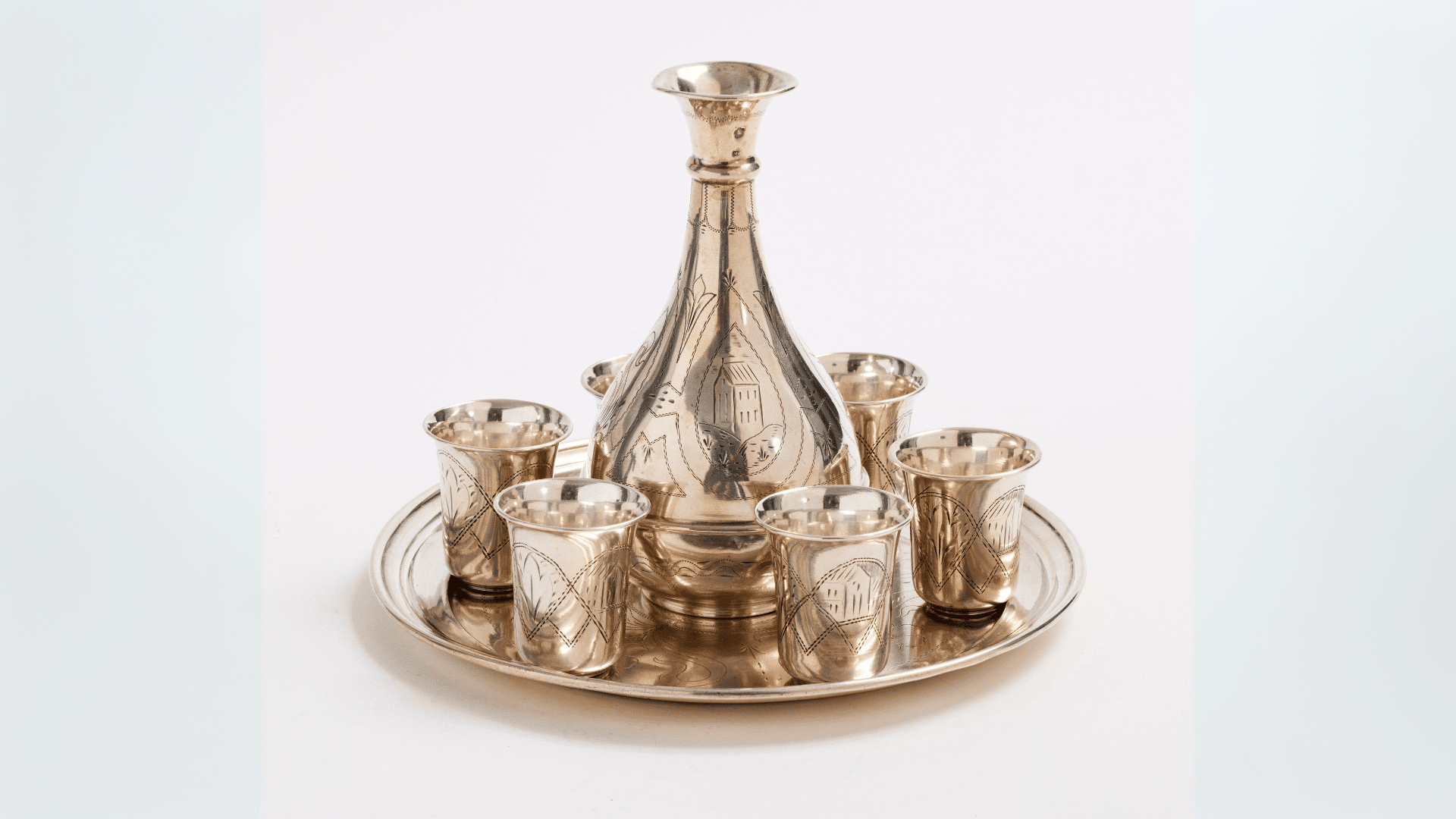
Silver kiddush set with platter, cups and decanter. SJM Collection.
Friday night
Shabbat, the Jewish day of rest, originates from the biblical narrative of Creation, where God rested on the seventh day after creating the world. The observance of Shabbat, from Friday sunset to Saturday sunset, commemorates this divine rest and is considered a foundational element of Jewish practice and identity.
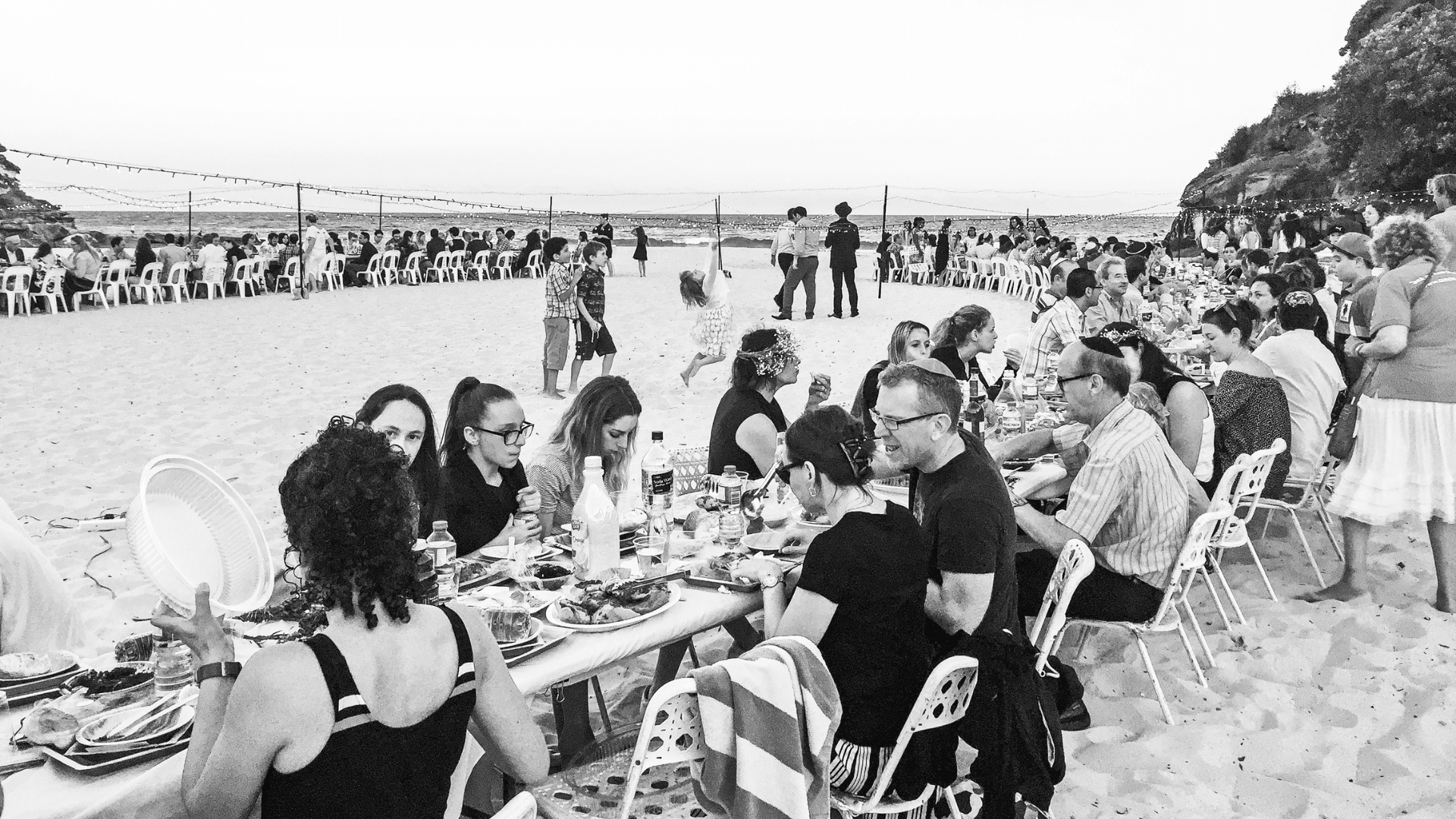
Photograph by D-Mo Zajac of a communal Shabbat dinner on Tamarama Beach, Sydney, 12 February 2016. SJM Collection.
Jewish music
Music plays a major role in Judaism, in particular the singing that takes place during synagogue services and at Shabbat and festival meals. Many of the melodies sung as prayer are hundreds, if not thousands, of years old.
Different communities across the world developed their own melodic traditions, often influenced by the musical practices prevalent in their wider societies. It is not uncommon today for Jewish communities to sing age-old prayers to the tune of the latest hits.
Traditionally, the use of musical instruments on Shabbat and festivals is forbidden by Judaism, but some modern streams of Judaism have permitted their use as a way to beautify synagogue services and make them more appealing to congregants. Outside the synagogue, instrumental music has played a central role in Jewish life, performed at celebratory events such as weddings and bnei mitzvot (coming-of-age ceremonies).
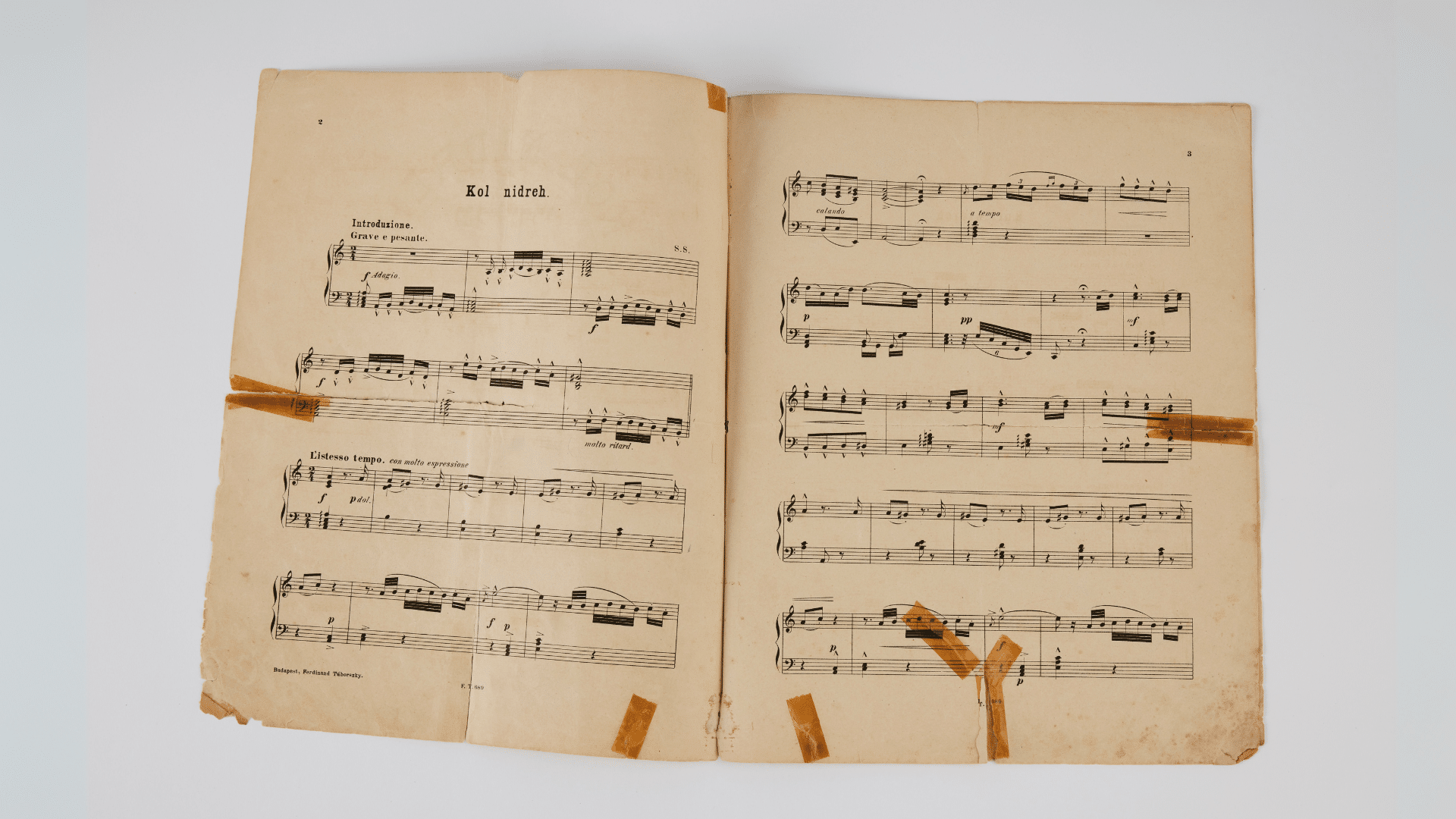
Sheet music for Kol Nidreh – the sacred and impassioned prayer of Yom Kippur – arranged for piano, printed in Budapest, Hungary in 1885. SJM Collection.
Lighting two candles
The Torah (the five books of the Hebrew Bible) commands Jewish people to ‘keep’ and ‘remember’ the Shabbat, or sabbath. Lighting candles is one way of ‘remembering’ Shabbat. This ritual is designed to make a distinction between the sanctity of the period of Shabbat and the secularity of the rest of the week.
The lighting of candles on Friday evening just before sunset symbolically marks the beginning of Shabbat. It is traditional for women to light the Shabbat candles, but many men will perform this ritual, too.
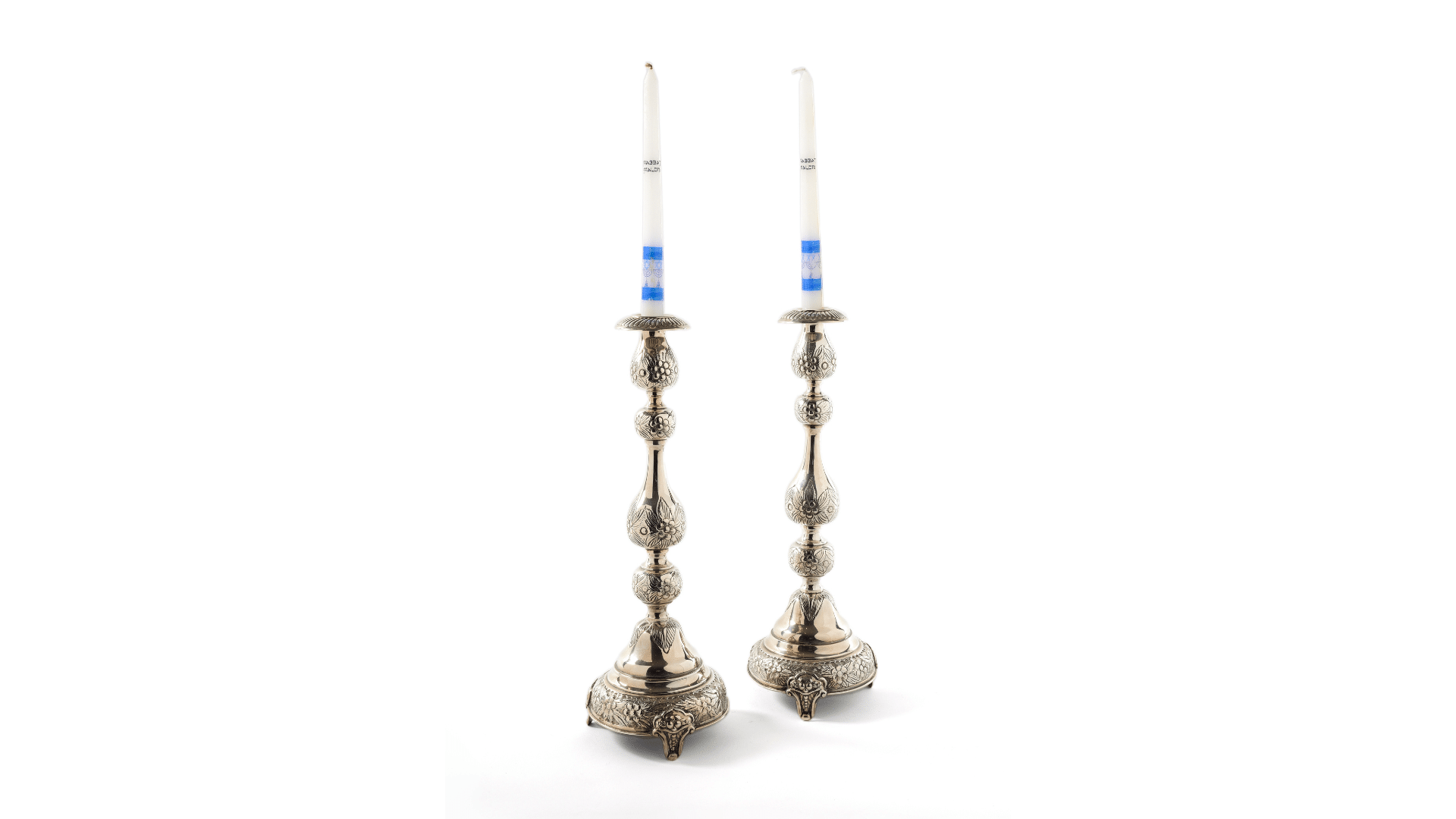
Pair of sterling silver Shabbat candlesticks, hallmarked London 1918. SJM Collection
Kabbalah
Kabbalah is a form of Jewish mysticism that explores the nature of God, the universe, the soul, and the hidden aspects of existence. It provides a symbolic and metaphysical framework for understanding creation, divine attributes, and spiritual development.
Kabbalah developed within Judaism, especially during the 12th to 13th centuries in Southern France and Spain. The foundational text is the Zohar. Today kabbalah is centred around the city of Safed in Northern Israel. The deep devotion of kabbalists is reflected in practices such as meditation, prayer, and study. Kabbalah has attracted attention in New Age and pop culture circles.
The red kabbalah string is a symbolic item worn, usually on the left wrist, as a form of spiritual protection. Whilst this is not the only practice of traditional kabbalah, it has become widely associated with pop culture interpretations of kabbalah.
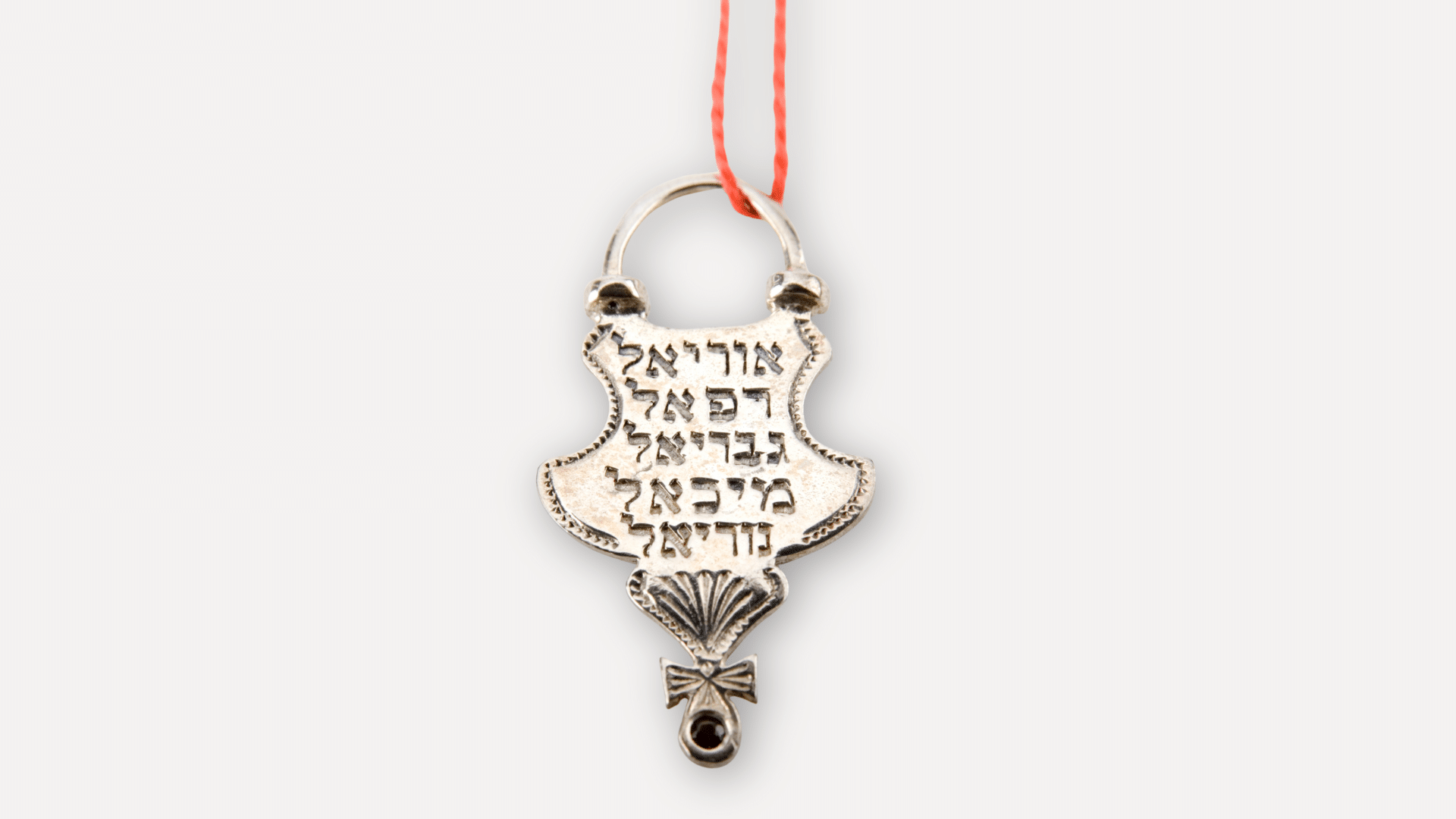
Amulet for a new born child inscribed with the names of the archangels. The talisman is a copy of a 16th century design and would be placed in a baby’s cot to ward off the ‘evil eye’. SJM Collection.
The evil eye
The evil eye features prominently in Jewish kabbalistic tradition, as well as other spiritual practices around the world.
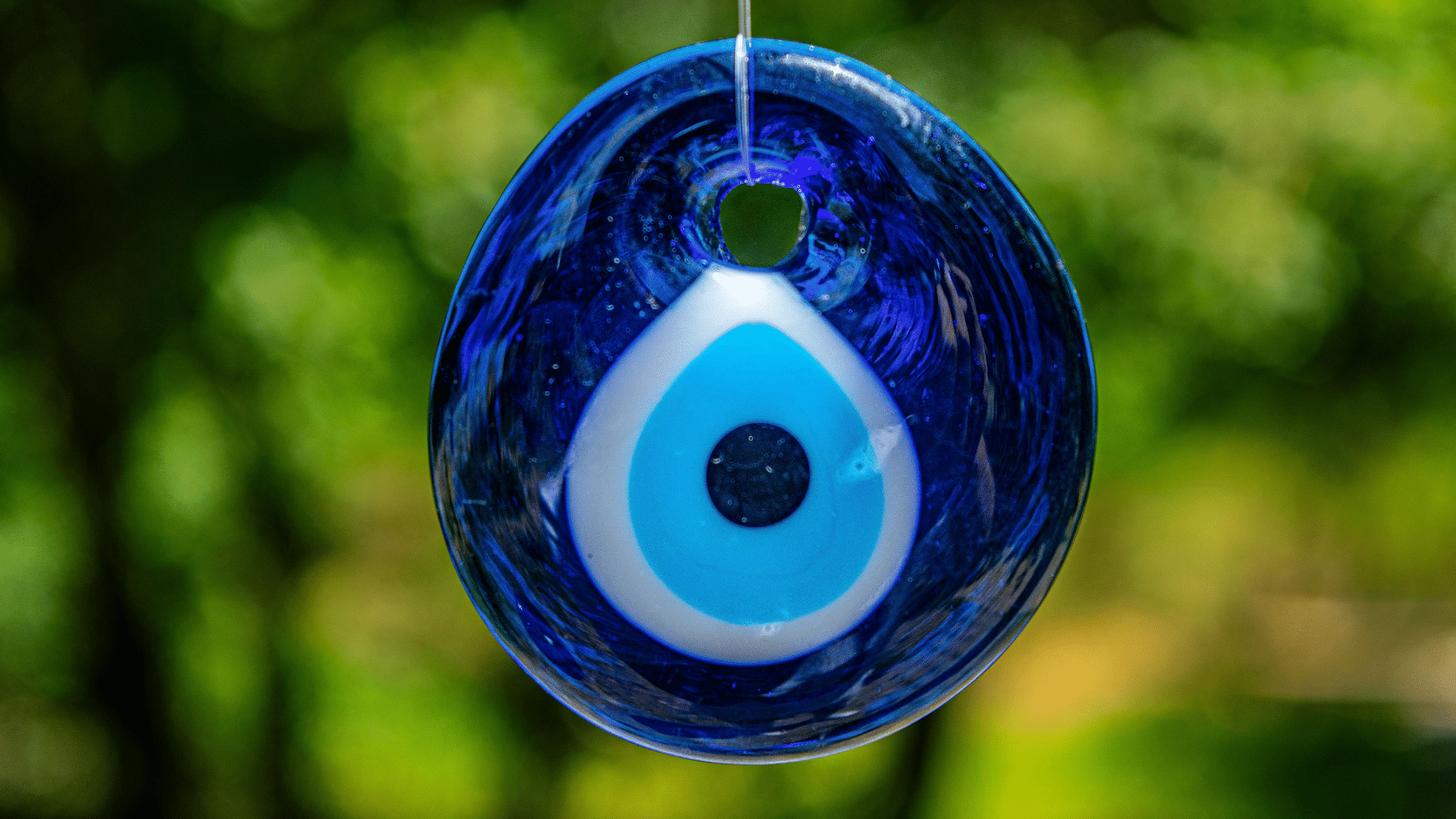
Blue Evil Eye Glass Pendant.
Havdalah
Havdalah is a Jewish ritual that marks the end of the Sabbath and ushers in the new week. It’s a brief but meaningful ceremony performed on Saturday night, after nightfall, once three stars are visible in the sky. The word havdalah means ‘separation’, and the ceremony emphasises the distinction between the sacred and the ordinary – between the sabbath and weekday, between light and darkness, and between rest and work.
As a part of the havdalah ceremony, fragrant spices (like cloves, cardamom or cinnamon) are passed around for people to smell. The spices are sniffed to carry the sweet spice of Shabbat into the week and to wake individuals gently back to their earthly responsibilities.
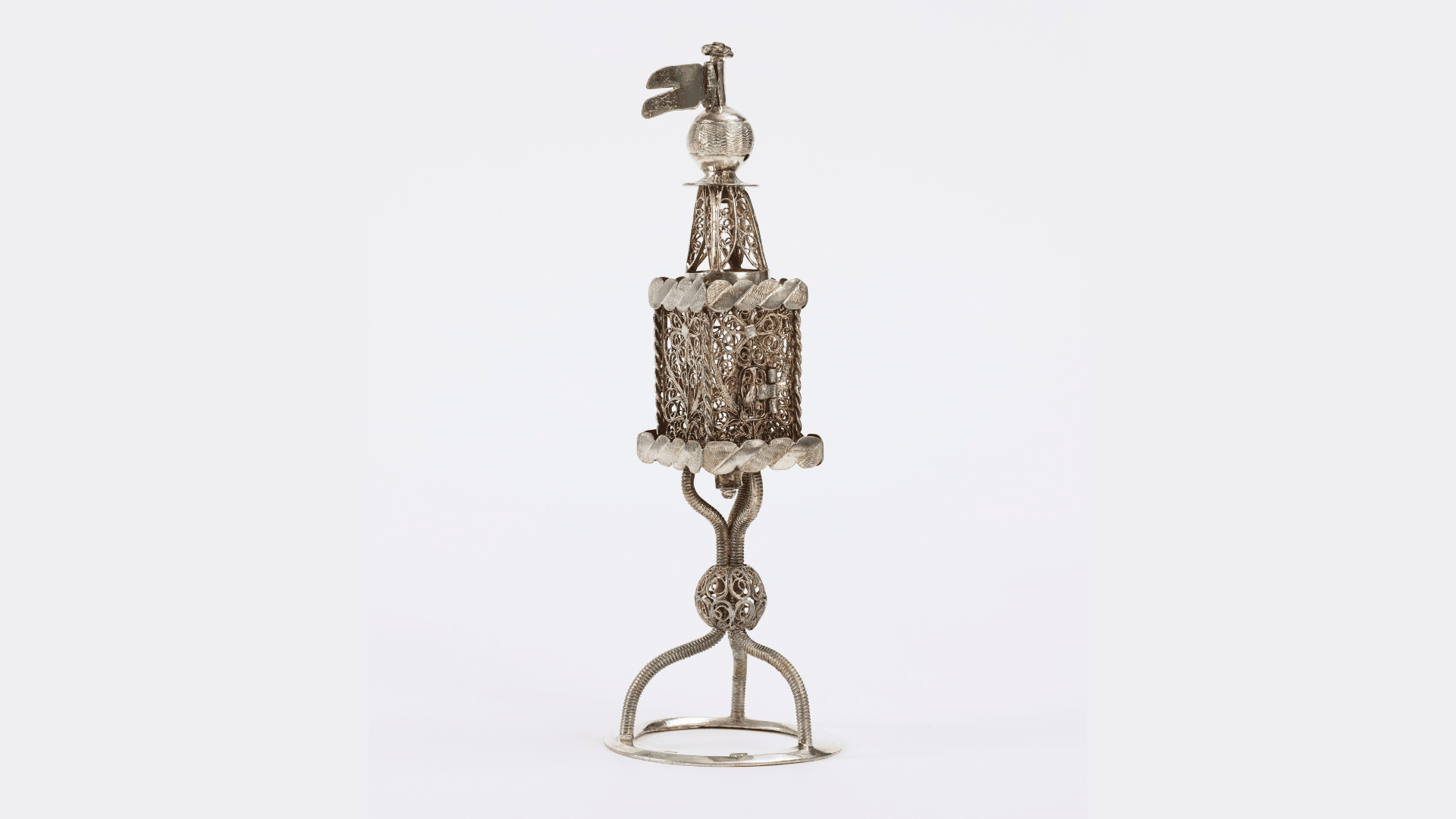
Havdallah Spice Tower, Austrian, circa 1870-1890. SJM Collection.
Challah
One of the most prevalent culinary traditions of Jews across time and place has been the challah loaves eaten at the Shabbat meal. In the Torah, ‘challah’ refers to the portion of dough set aside as an offering to God. Today, challah commonly takes the form of a plaited loaf of bread (probably originating in Austria or Bavaria), but many Jewish communities throughout history have baked different varieties of challah.
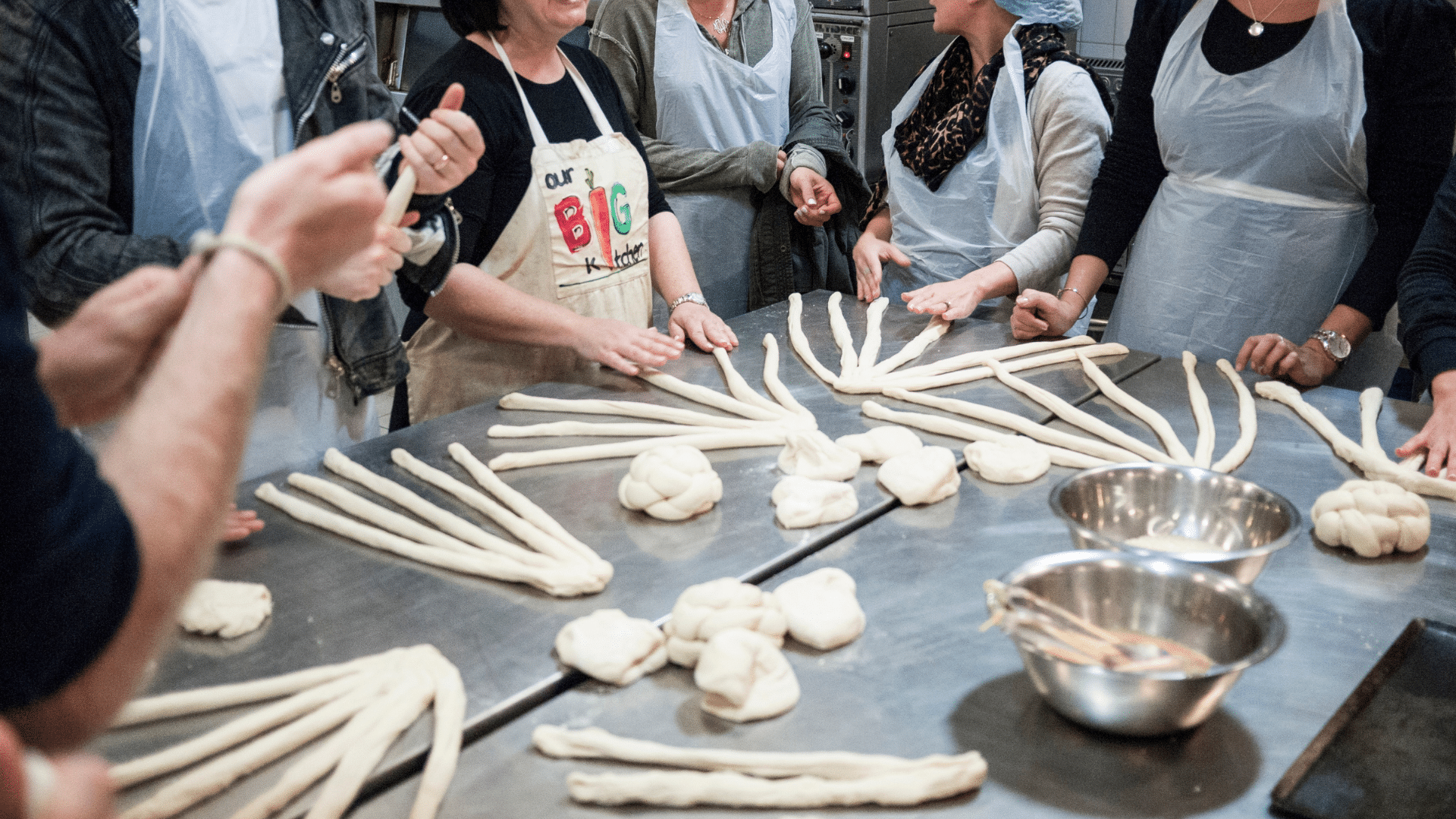
Colour photograph of Rebbitzen Laya Slavin baking Challah in Our Big Kitchen (OBK), Bondi, 2013. Photographer: D-Mo Zajac. SJM Collection.
Chicken matzah ball soup
Affectionately known as ‘Jewish penicillin’, chicken soup and matzah balls (known in Yiddish as kneydlekh) is one of the most widely recognised Jewish foods. However, not all Jews serve this dish.

Matzah ball soup. Courtesy of Canva.
Jewish soul food
As Jews migrated across the world, they developed different culinary traditions, often influenced by the other peoples among whom they lived, but with a particular ‘Jewish’ flavouring due to Jewish dietary laws and rules concerning the preparation of food on Shabbat. For example, a popular dish served at Shabbat lunch is the one-pot stew known as ‘chulent’ by Ashkenazi Jews and ‘hamin’ by Sephardi and Mizrahi Jews. Due to the prohibition against cooking on Shabbat, this dish was traditionally prepared in advance and cooked slowly overnight in a large communal oven (often hosted at kosher bakeries) and collected after the Shabbat morning service on the way home from synagogue. Today, slow cookers have made the preparation of this Shabbat favourite far more convenient.
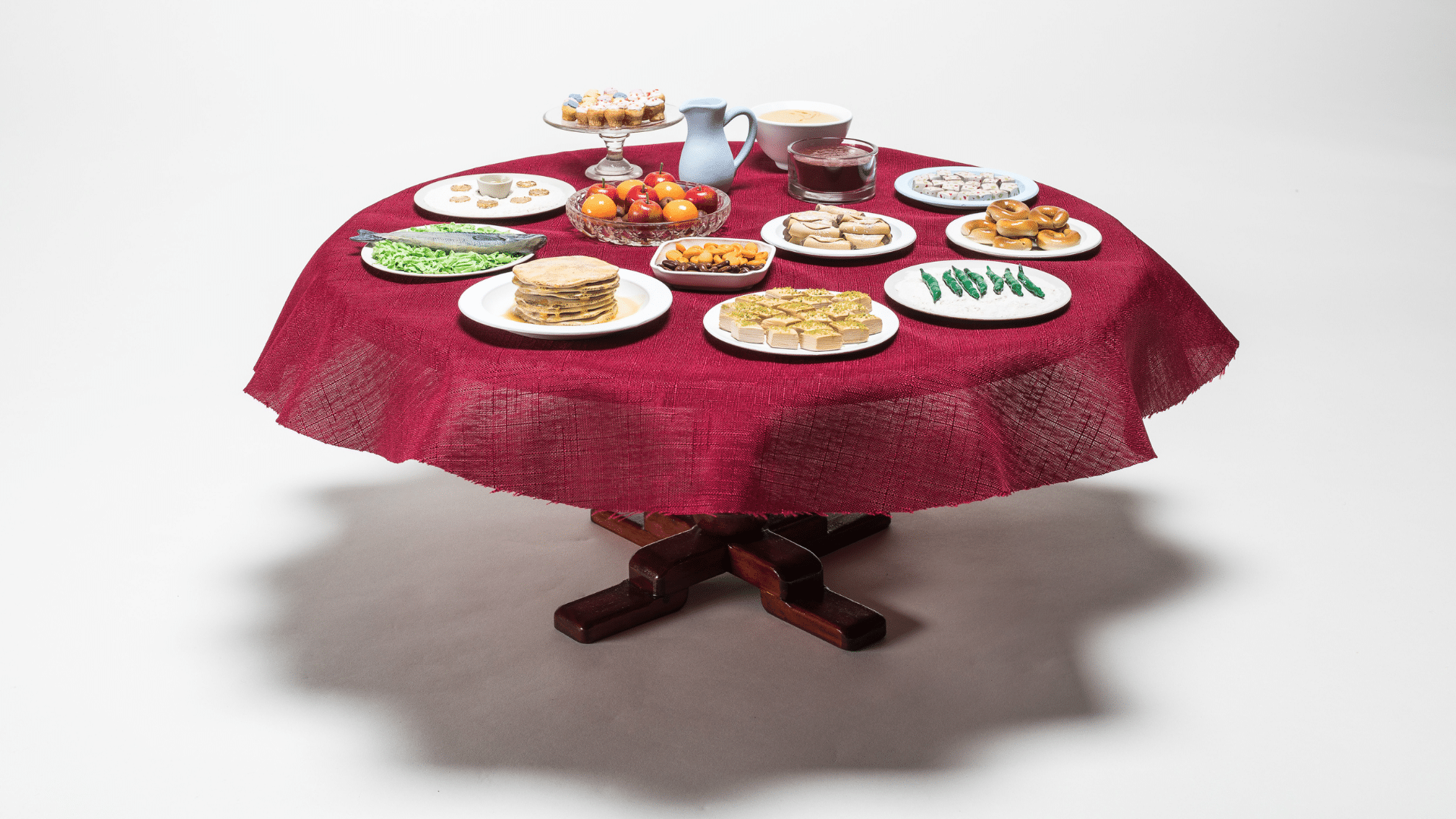
Miniature of a table set with food for Mimouna, a feast celebrated by Moroccan Jews. SJM Collection.
Breaking a glass
At the end of a Jewish wedding ceremony, it is customary for one, and sometimes both people in the couple, to break a glass. There are many interpretations of this ritual. Some consider it a reminder of the destruction of the Temple in Jerusalem in the first century, for even at the height of personal joy, we must not forget the tragedies the Jewish and world communities have endured. Others explain that the fragile glass reminds us of the delicate nature of marriage, which must always be cared for and cherished. At the sound of the breaking of the glass, guests traditionally clap and chant “Siman tov” and “mazel tov,” Hebrew phrases that offer congratulations and good luck to the couple.
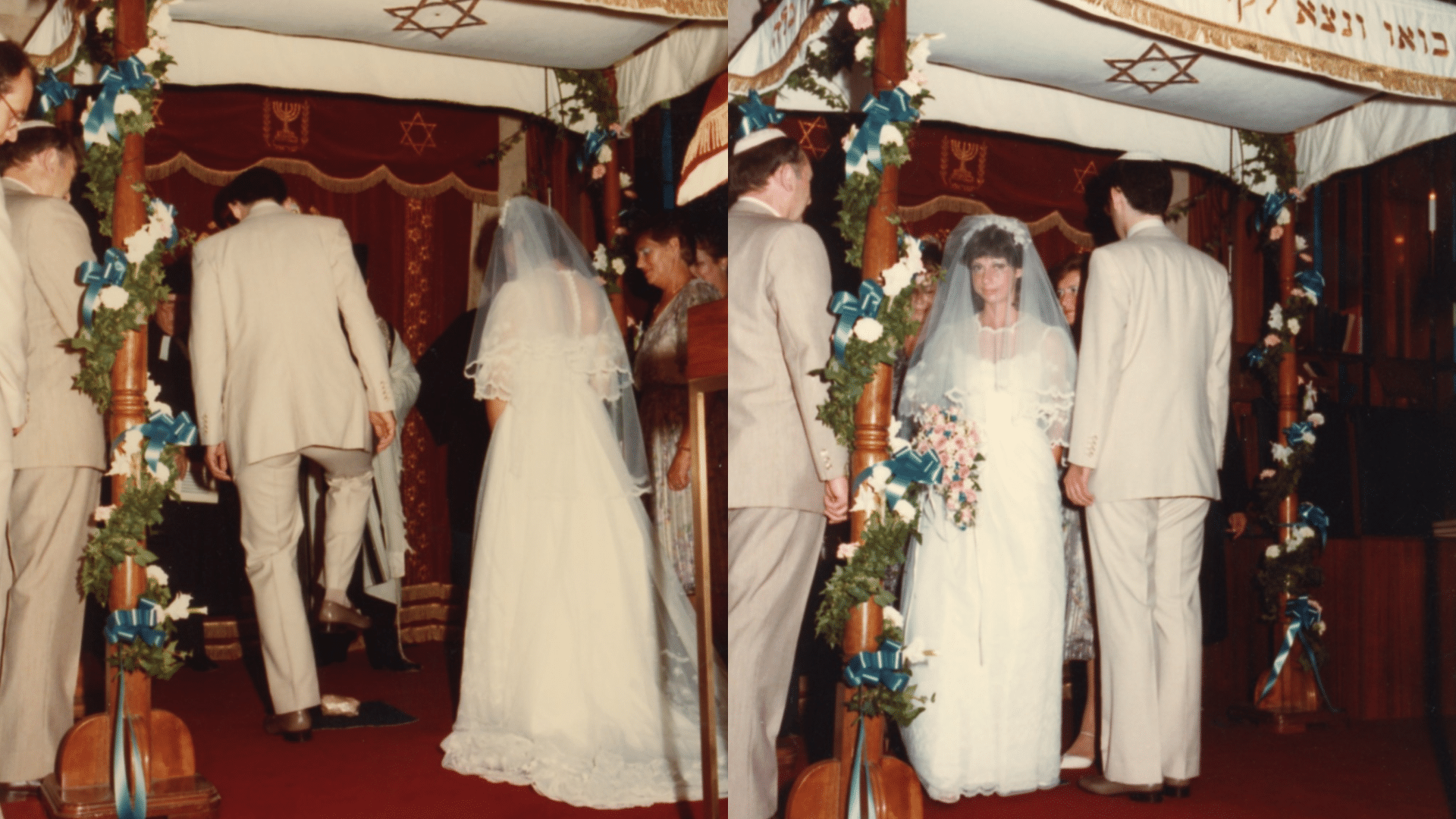
Images photographed by David Huban representing some of the rituals and customs at a Jewish wedding, 1983. SJM Collection.
Jewish wedding traditions
Breaking a glass might be the best-known Jewish wedding tradition. However, a Jewish wedding is filled with traditions that are highly symbolic and hundreds of years old. Here are a few more.
Bedeken – This is the ‘veiling’ ceremony, where the groom lowers the bride’s veil, before the central marriage ceremony takes place. Some day this ritual has its roots in two biblical narratives. The first time in the Torah (the five books of the Hebrew Bible) we learn of love between two people is when Isaac and Rebcca meet. Out of modesty and humility, Rebecca lowers her veil and Isaac is so taken by her aura and beauty that he falls to the ground. In a second narrative, Jacob is tricked by his father-in-law into marrying Leah, who is presented to him as an already-veiled bride. Only after the ceremony did he discover that she was not Rachel, his intended bride.
Henna party – Among Sephardic Jews (those who originated in Spain and the Iberian Peninsula) and Mizrahi Jews (those from the Middle East and North Africa), the bedeken isn’t part of the wedding day. Instead, a henna party may be held the week before the wedding ceremony, during which henna is applied to the palms of the wedding couple. These markings make them easily identifiable on the day of the wedding and may, according to some, product them from the “evil eye” at this joyous time in their lives.
Chuppah – The wedding ceremony takes place under a canopy – called a chuppah – which represents God’s sheltering presence in the lives of the couple, as well as the new home they will build together. The presence of family members under the chuppah, as well as its lack of walls, signify that family and friends will always be welcome in the couple’s home.
Circling – Among Ashkenazi Jews (those from eastern and central Europe), it is customary for one partner to circle the other seven times before entering the chuppah. This tradition alludes to the seven days of creation and as a reminder that marriage is itself a process of creation. More recently, many heterosexual and queer couples choose to circle each other three times, adding one final circle together.
What’s On Newsletter
Keep up to date on all Museum events and exhibitions.